
Advertisement

This page tells all about the beautiful northern lights, otherwise known as auroras.
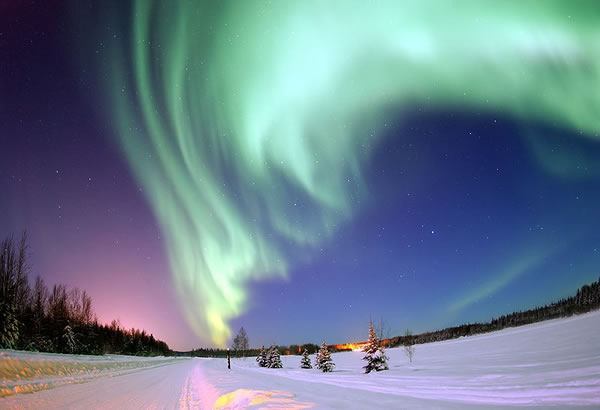
What is the Aurora Borealis?
Auroras, often called Northern Lights (Aurora Borealis) and Southern Lights (Aurora Australis) are spectacular light displays most commonly viewed in the polar regions. Auroras occur because of interactions between Earth's magnetic field and solar winds. The solar wind is a stream of charged particles emitted from the sun's corona that travels far into space at speeds of up to 400 miles per second. Charged particles within the solar winds collide with atmospheric atoms and molecules when they reach Earth's magnetic field. The collisions cause quantum leaps, which means the kinetic energy within the electrons of the particles are converted to light. The collisions of different particles result in different colored lights. Atomic oxygen produces red and green lights, nitrogen produces pink, blue, or violet light, helium produces purple lights and neon produces rippled orange light. Auroras come in a vast array of shapes and forms such as arcs, swirls, "curtains" and glowing shapes. They often appear to be moving.
Why do Auroras Occur?
Auroras often occur as a result of a geomagnetic storm. A geomagnetic storm is the temporary disturbance of the Earth's magnetic field as a result of an event in space such as a solar flare or coronal mass ejection (the ejection of charged particles form the sun's corona). In noteworthy geomagnetic storms, Auroras can be seen well south (or north) of where they are usually occur. The famous Great Geomagnetic Storms of 1859 produced what witnesses call the most spectacular auroras ever seen. Such auroras were seen throughout the United States, Japan, and Australia. The event lasted for almost a week.
Advertisement

Related activities
Advertisement