Advertisement

This page describes the land, economy, culture, and religions of the Mid-Atlantic (Middle) Colonies
The Middle Colonies were New York, New Jersey, Pennsylvania, and Delaware. Located in the Mid-Atlantic region, these colonies were known for fertile farmland, busy ports, religious diversity, and a strong economy based on agriculture, trade, and skilled crafts.
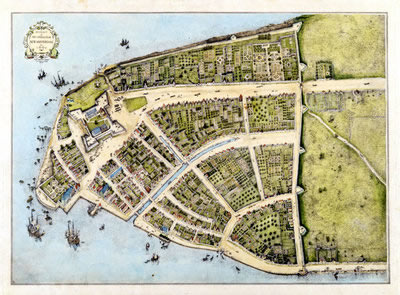
New Amsterdam
Which Colonies Were the Middle Colonies?
Middle Colonies at a Glance
| Colony | Economy and Resources | Religion and Culture | Important Features |
|---|---|---|---|
| New York | Farming, trade, shipping, and skilled crafts | Religiously and culturally diverse | New York City became an important port and trading center |
| New Jersey | Farming, livestock, and trade | Several religious groups settled there | Fertile farmland and a location between New York and Philadelphia |
| Pennsylvania | Grain farming, trade, manufacturing, and crafts | Known for religious tolerance and a large Quaker population | Philadelphia became one of the largest cities in colonial America |
| Delaware | Farming and trade | Religiously diverse | Access to the Delaware River and Atlantic trade routes |
Climate and Geography of the Middle Colonies
The Middle Colonies spanned the Mid-Atlantic region of America and had a temperate climate, with warm summers and cold winters. Geography ranged from coastal plains along the coastline to piedmont, or rolling hills, in the middle and mountains farther inland.
The region had excellent coastal harbors for shipping, while its climate and fertile land were well suited for agriculture. These natural advantages helped the Middle Colonies develop both successful farms and important trading cities.
Why Were the Middle Colonies Called the Breadbasket Colonies?
The Middle Colonies were often called the "breadbasket colonies" because their fertile soil and favorable climate allowed farmers to grow large amounts of grain. Wheat, barley, oats, and rye were especially important crops. These grains could be used locally or shipped to other colonies and overseas markets.
Agriculture became one of the foundations of the region's economy, while ports such as Philadelphia and New York helped farmers and merchants sell their products to distant markets.
Religion in the Middle Colonies
Religion in the Middle Colonies was varied, and no single religion dominated the entire region. Religious tolerance attracted immigrants from many different countries and backgrounds. Quakers, Catholics, Jews, Lutherans, Presbyterians, and other religious groups established communities throughout the Middle Colonies.
Pennsylvania became especially well known for religious tolerance. William Penn and the Quakers supported the idea that people should have greater freedom to practice their religious beliefs.
Learn more about the Quakers in colonial America.
Economy of the Middle Colonies
The Middle Colonies enjoyed a successful and diverse economy. Agriculture was extremely important, and farms throughout the region grew many crops, especially grains.
Logging, shipbuilding, textile production, and papermaking were also important industries. Large cities such as Philadelphia and New York became major shipping and trading centers. Craftspeople including blacksmiths, silversmiths, cobblers, wheelwrights, wigmakers, and milliners contributed to the growing urban economy.
How Were the Middle Colonies Different from the Other Colonial Regions?
| Region | Geography | Economy | Religion and Society |
|---|---|---|---|
| New England Colonies | Rocky soil, forests, cold winters, and a long coastline | Fishing, shipbuilding, trade, and small farms | Puritan influence was especially strong in several colonies |
| Middle Colonies | Fertile farmland, rivers, good harbors, and a moderate climate | Grain farming, trade, shipping, manufacturing, and crafts | Especially diverse in religion, ethnicity, and culture |
| Southern Colonies | Long growing seasons, fertile coastal plains, and warm climate | Agriculture, including major cash crops | Plantation agriculture strongly influenced society and settlement |
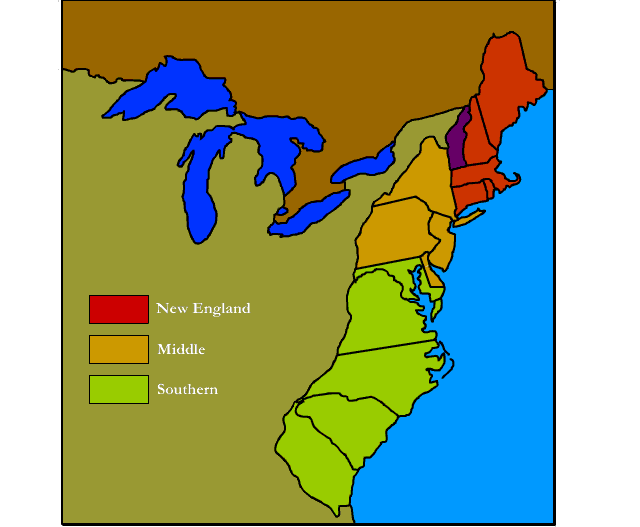
Regions of the 13 Colonies
Explore the Three Regions of the 13 Colonies
Middle Colonies and 13 Colonies Activities
Continue learning about the Middle Colonies and the other colonial regions with these interactive activities and classroom resources.
- Middle Colonies Correct-Me Passage
- 13 Colonies Regions Categorization by Colony
- 13 Colonies Regions Categorization by Fact
- New England Colonies Correct-Me Passage
- Southern Colonies Correct-Me Passage
More Articles About Life in the 13 Colonies
- Life in Puritan Massachusetts
- Who Were the Quakers?
- Tobacco in the Southern Colonies
- History of Cotton in America
- Indigo in the South Carolina Colony
- Highlights of a Colonial Town: Williamsburg
13 Colonies Reading Comprehension Activities
- Life in Puritan Massachusetts Reading Passage and Critical Thinking Questions - Printable
- Life in Puritan Massachusetts Reading Passage and Critical Thinking Questions - Online
- Who Were the Quakers? Reading Passage and Critical Thinking Questions - Printable
- Who Were the Quakers? Reading Passage and Critical Thinking Questions - Online
- Tobacco in the Southern Colonies Reading Passage and Critical Thinking Questions - Printable
- Tobacco in the Southern Colonies Reading Passage and Critical Thinking Questions - Online
- History of Cotton Reading Passage and Critical Thinking Questions - Printable
- History of Cotton Reading Passage and Critical Thinking Questions - Online
- Religion in the 13 Colonies Compare-and-Contrast Reading Comprehension
Teaching the 13 Colonies?
Explore more MrNussbaum activities for the 13 Colonies, including interactive games, reading-comprehension activities, maps, printable resources, and classroom materials.
Start with the activities above, then explore additional 13 Colonies resources and subscriber-only materials for deeper practice and classroom use.
Advertisement

Related activities
Advertisement