This page describes the Boston Tea Party and its causes and effects.
Boston Tea Party and the Intolerable Acts
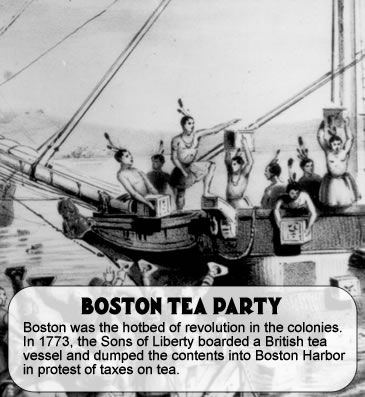
The Boston Tea Party was one of the most important events leading to the American Revolution. On December 16, 1773, colonists in Boston destroyed tea belonging to the British East India Company to protest Parliament's policies and its continued tax on tea. Britain's harsh response increased tensions between the colonies and Great Britain and helped bring the colonies closer together in opposition to British rule.
This article explains the causes of the Boston Tea Party, what happened on the night of December 16, 1773, and how Parliament responded with laws that became known in America as the Intolerable Acts.
Looking for more Boston Tea Party resources? Visit the Boston Tea Party Learning Center for games, reading comprehension, printables, activities, and other student resources.
The Tea Act and the East India Company
Even after tensions in Boston temporarily eased, many colonists remained angry about Parliament's attempts to tax and regulate the colonies. The continuing tax on tea was especially irritating because many colonists believed Parliament had no right to tax them without their consent.
In 1773, Parliament passed the Tea Act. The law allowed the British East India Company to sell tea directly in the American colonies, giving the company an important advantage in the colonial tea trade. Because the company could avoid some of the usual middlemen, its tea could actually be sold at a lower price.
The lower price did not satisfy many colonists. They believed purchasing the tea would mean accepting Parliament's right to tax them. Colonial merchants also feared the special advantages given to the East India Company. Opposition spread throughout the colonies, and protesters in several ports prevented British tea from being unloaded.
Destruction of the Tea
Boston presented a different problem. Royal Governor Thomas Hutchinson refused to allow the tea ships to leave without unloading their cargo and paying the required duties.
On the night of December 16, 1773, groups of colonists boarded three ships in Boston Harbor: the Dartmouth, the Eleanor, and the Beaver. Some participants used disguises or markings intended to evoke Native Americans, particularly Mohawk people.
The protesters broke open 342 chests of East India Company tea and dumped their contents into Boston Harbor. The destruction of the tea became known as the Boston Tea Party.
Britain Responds with the Intolerable Acts
The Boston Tea Party was important not only because of the destruction of the tea, but also because of Britain's response. Parliament wanted to punish Boston and demonstrate that colonial resistance to British authority would have serious consequences.
In 1774, Parliament passed four punitive laws aimed primarily at Massachusetts. In Britain, these laws were known as the Coercive Acts. American colonists called them the Intolerable Acts because they believed the laws were unjust and threatened colonial rights and self-government.
The Four Intolerable Acts
1. Boston Port Act - This law closed the port of Boston to most commercial traffic until compensation was made for the destroyed tea. The measure damaged Boston's economy and affected many people who had taken no part in the Tea Party.
2. Massachusetts Government Act - This law sharply reduced self-government in Massachusetts. It altered the colony's charter, increased the power of the royal governor, and placed new restrictions on town meetings.
3. Administration of Justice Act - This law allowed certain royal officials accused of crimes connected with enforcing British authority to have their trials moved outside Massachusetts.
4. Quartering Act - This law expanded the authority of colonial officials to provide suitable quarters for British troops when existing military housing was unavailable.
Was the Quebec Act an Intolerable Act?
Parliament also passed the Quebec Act in 1774. It was separate from the four Coercive Acts and was not passed specifically to punish Boston. However, many American colonists grouped the Quebec Act together with the four punitive laws and referred to all of them collectively as the Intolerable Acts.
The Quebec Act expanded the boundaries of the Province of Quebec into territory west of the Appalachian Mountains and established new rules for governing that territory. Colonists who claimed or hoped to settle western lands strongly opposed the law.
From the Boston Tea Party to the Continental Congress
Instead of isolating Boston, Britain's punishment helped create sympathy for Massachusetts throughout the colonies. Colonial leaders increasingly viewed the dispute with Britain as a problem affecting all of the colonies rather than Massachusetts alone.
In September 1774, delegates from twelve colonies met in Philadelphia at the First Continental Congress. The meeting was an important step toward greater colonial cooperation and, eventually, the American Revolution.
Explore the complete topic: Visit the Boston Tea Party Learning Center for additional articles, games, reading comprehension activities, printables, and classroom resources.
Boston Tea Party Articles
- Boston Tea Party - Basic Description - A short article about the Boston Tea Party for younger readers.
- Mob Etiquette? The Surprising Rules of the Boston Tea Party - Learn about the strict rules participants followed during the Boston Tea Party.
- The East India Company - Learn about the history and power of Britain's East India Company and the role it played in the Boston Tea Party.
- The Sons of Liberty - Learn about the formation, role, and influence of the Sons of Liberty.
Boston Tea Party Printable Activities
- Boston Tea Party Reading Comprehension - This resource includes a historical passage and four multiple-choice questions.
- Boston Tea Party Reading Comprehension - Basic - This resource includes a historical passage and four multiple-choice questions with immediate feedback.
- Mob Etiquette Reading Comprehension - This resource includes a historical passage about the rules of the Boston Tea Party and seven multiple-choice questions.
- Sons of Liberty Reading Comprehension - This resource includes a historical passage about the Sons of Liberty and seven multiple-choice questions.
- Boston Tea Party Fact or Fiction - Students read a Boston Tea Party passage and sort 11 statements into those that are facts and those that are fiction.
- Boston Tea Party Virtual History Teacher - Students play the role of a history teacher and complete missing information in responses to questions about the Boston Tea Party.
- Punishment! - Boston Tea Party Writing Prompt - Students connect the punishments imposed on the colonists after the Boston Tea Party to an experience involving a punishment they considered unfair.
- The Tolerable Acts - Reimagining Britain's Response to the Boston Tea Party - Students imagine themselves as members of Parliament and create alternative laws designed to improve relations with the colonies.
Boston Tea Party Online Activities
- Boston Tea Party Reading Comprehension - This resource includes a historical passage and ten multiple-choice questions with immediate feedback.
- Boston Tea Party Reading Comprehension - Basic - This resource includes a basic-level historical passage and four multiple-choice questions with immediate feedback.
- Boston Tea Party Reading Comprehension - Main Idea Focus - This resource includes a Boston Tea Party passage and five questions focused on identifying the main idea.
- Boston Tea Party Reading Comprehension - Sequencing Focus - This resource includes a Boston Tea Party passage and five questions focused on sequencing events.
- Boston Tea Party Reading Comprehension - Vocabulary Focus - This resource includes a Boston Tea Party passage and five questions focused on contextual vocabulary.
- Boston Tea Party Reading Comprehension - Details Focus - This resource includes a Boston Tea Party passage and five questions focused on important details.
- Mob Etiquette Reading Comprehension - This resource includes a historical passage about the rules of the Boston Tea Party and seven questions with immediate feedback.
- Sons of Liberty Reading Comprehension - This resource includes a historical passage about the Sons of Liberty and ten multiple-choice questions with immediate feedback.
- Boston Tea Party Fact or Fiction - Students read a Boston Tea Party passage and sort 11 statements into those that are facts and those that are fiction. Immediate feedback is provided.
- Boston Tea Party Correct-Me Passage - Students identify eight factual errors in a Boston Tea Party passage and select the correct information.
- Boston Tea Party Paragraph Paramedics - Students find and correct spelling, punctuation, and usage errors in a Boston Tea Party paragraph.
- Boston Tea Party and Intolerable Acts PowerPoint Presentation - This 14-slide presentation explains the Boston Tea Party, monopolies, the East India Company, and the Intolerable Acts.
- Not Boring Jeopardy - American Revolution Edition - A customizable American Revolution review game for classrooms, individuals, or small teams.
More Boston Tea Party resources: Visit the Boston Tea Party Learning Center.
Related activities
Advertisement