South Carolina Starts it All
On December 24, 1860, the state of South Carolina issued its "Declaration of the Immediate Causes Which Induce and Justify the Secession of South Carolina from the Federal Union." In the declaration, South Carolina claimed the U.S. Constitution gave a state the right to secede if the Federal Government failed to uphold its "obligations" to a state. More specifically, South Carolina asserted that the Government failed to enforce the Fugitive Slave Law in all states, and the election of Abraham Lincoln signaled the end of slavery, an institution on which South Carolina ’s economy was dependent upon.
Two Waves of Secession
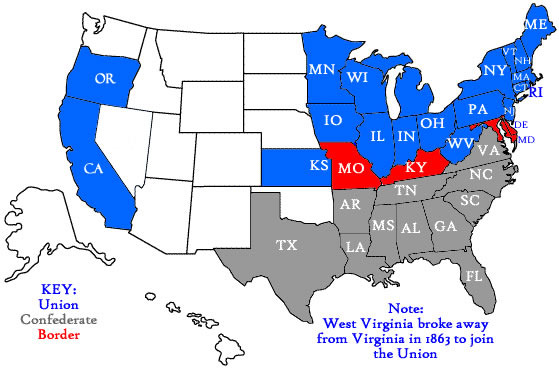
Georgia, Texas, and Mississippi soon followed South Carolina's lead and issued Declarations of Secession. Tennessee, North Carolina, Florida, Alabama, Arkansas, and Virginia would also secede. Together, the seceding states formed the Confederate States of America, though it would never be recognized as a sovereign nation by other world powers. Nevertheless, the Confederate States wrote a constitution, elected Jefferson Davis as President, built a military, and placed their original capital in Montgomery, Alabama before moving it to Richmond, Virginia.