Advertisement

This page tells about the history of the Connecticut Colony.
Connecticut Colony
The Connecticut Colony developed along the Connecticut River during the early 1600s. Dutch traders arrived first, followed by English Puritans from Massachusetts. The colony's history included conflict with the Pequot people, the creation of the Fundamental Orders of Connecticut, and the granting of a royal charter in 1662.
Early Settlement of Connecticut
Connecticut was originally settled by Dutch fur traders in 1614. They sailed up the Connecticut River and built a fort near present-day Hartford.
Arrival of the English Settlers
The first English settlers arrived in Connecticut in 1633 under the leadership of Reverend Thomas Hooker. They were Puritans from the Massachusetts Bay Colony. After their arrival, several settlements and colonies were established, including the Connecticut Colony, Saybrook, Windsor, Hartford, and New Haven. Hartford quickly became an important center of government and trade.
The Pequot War
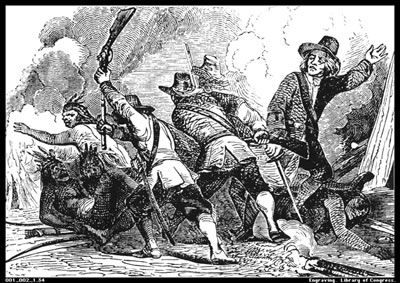
Much of the land settled by the colonists was purchased from the Mohegan Indians. The Pequot tribe, however, also claimed land in the region. Violence soon erupted between settlers and the Pequots in 1637. In what became known as the Pequot War, the Pequots suffered devastating losses at the hands of English settlers and their Mohegan and Narragansett allies, both of whom had previously fought against the Pequots. After the war, Pequot lands were divided among the settlers and other Native American groups.
The Fundamental Orders of Connecticut
After the Pequot War, Thomas Hooker helped lead the drafting of the Fundamental Orders of Connecticut in 1639. The document established a plan of government for the colony and is sometimes described as one of America's earliest written constitutions. John Haynes was chosen as Connecticut's first governor.
Connecticut Receives a Royal Charter
In 1662, Connecticut received a royal charter from King Charles II. The charter gave the colony an official legal basis and recognized its government under the authority of the English crown.
Why it mattered: Connecticut's early system of representative government and the Fundamental Orders helped establish traditions of self-government that later became important in American political life.
13 Colonies Navigation
Advertisement

Related activities
Advertisement