Advertisement

This page tells about the history of the Rhode Island Colony.
Rhode Island Colony
The Rhode Island Colony was closely connected to the ideas and leadership of Roger Williams, a religious dissenter who challenged the authorities of Massachusetts Bay. His belief in religious freedom, fair treatment of Native peoples, and separation of church and government helped make Rhode Island one of the most tolerant colonies in early America.
Roger Williams Challenges Puritan Massachusetts
Like many English Puritans, Roger Williams came to Massachusetts during the Great Migration, when thousands of Puritans left England and settled in New England. When Williams arrived, however, he believed that the Puritan church had not separated itself enough from the Church of England. For this reason, he refused a position as minister of the church in Boston. Williams became even more controversial when he argued that the colony's charter did not give settlers a legitimate claim to Native American lands because the land had not been purchased from its original inhabitants. He later moved to Salem, where he also spoke against using taxes to support churches and against laws requiring people to attend religious services.
Religious Freedom and Separation of Church and State
Although Williams came from a Puritan background, he strongly opposed laws that forced people to follow particular religious beliefs. He argued that government should not control an individual's religious faith and became one of the strongest early supporters of religious liberty and the separation of church and government. His ideas were unusual for the time and placed him in direct conflict with the leaders of the Massachusetts Bay Colony.
Williams Is Banished
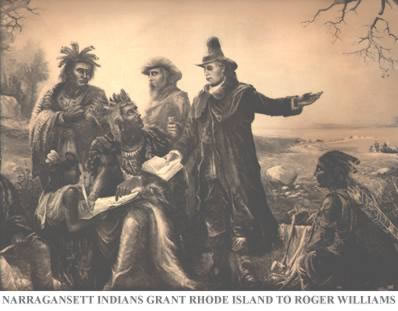
Puritan leaders feared that Williams's teachings might weaken the authority of both the church and the colonial government. In the fall of 1635, colonial officials ordered him banished from Massachusetts. Before he could be forced to leave, Williams departed on his own in January 1636 and traveled through the New England wilderness. With assistance from Native peoples in the region, he eventually reached Narragansett Bay and acquired land from the Narragansett people. There he founded the settlement of Providence.
The Founding of Rhode Island
Williams established Providence as a community where residents could practice their religions freely. The government of the settlement allowed greater religious participation than was common in many other colonies and welcomed people whose beliefs were unpopular elsewhere. In 1644, Williams obtained a parliamentary patent in England for the settlements around Narragansett Bay. In 1647, Providence, Portsmouth, Newport, and Warwick united under a single government, forming the colony that became Rhode Island.
Why it mattered: Rhode Island became known for religious tolerance and helped establish important American traditions involving freedom of conscience and the separation of religion from government.
13 Colonies Navigation
- Massachusetts Bay Colony
- New Hampshire Colony
- Connecticut Colony
- Rhode Island Colony
- New York Colony
- New Jersey Colony
- Pennsylvania Colony
- Delaware Colony
- Maryland Colony
- Virginia Colony
- North Carolina Colony
- South Carolina Colony
- Georgia Colony
Other 13 Colonies Articles
Advertisement

Related activities
Advertisement