Advertisement
Common Core Math - Grade 2 - Interactive Activities
This section contains hundreds of interactive activities that align to Grade 2 Common Core Standards. These give immediate feedback.
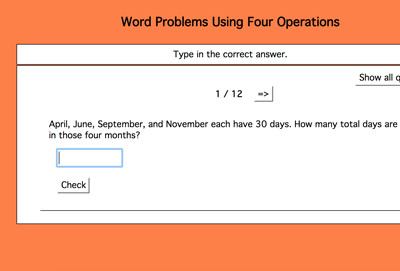
2.OA.A.1 - Grade 2 Common Core - Word Problems with Two-digit Addition and Subtraction
Description: This activity involves students solving word problems in addition and subtraction with two-digit numbers.
2.OA.C.3 - Grade 2 Common Core - Odd or Even Pictures
Description: This activity involves students determining whether the picture shows an odd or even number of members.
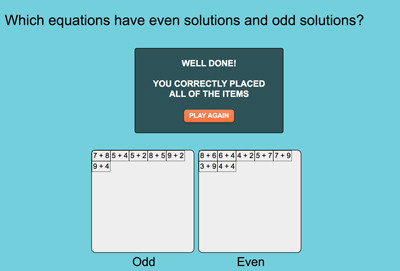
2.OA.C.3 - Grade 2 Common Core - Odd or Even Drag and Drop
Description: This activity involves students dragging the number to the correct odd or even container.
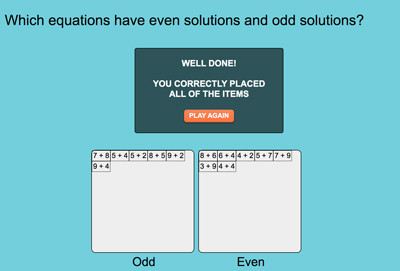
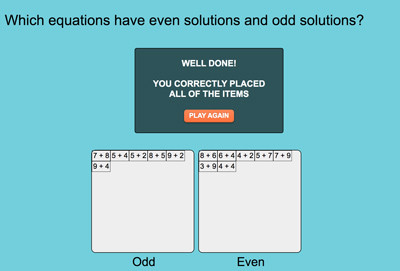
2.OA.C.3 - Grade 2 Common Core - Odd or Even Solutions
Description: This activity involves students dragging the equations with odd solutions and even solutions to the correct containers.
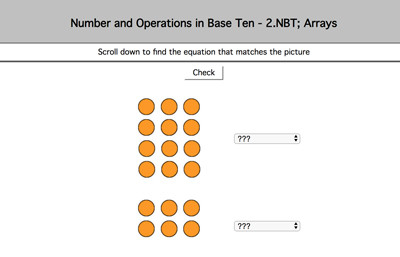
2.OA.C.4 - Grade 2 Common Core - Rectangular Arrays
Description: This math drill requires students to answer questions about the rectangular arrays. Immediate feedback is given.
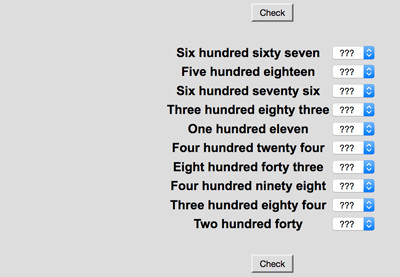
2.NBT.A.1 - Grade 2 Common Core - Place Value - Matching Numbers to Their Written Words
Description: This activity requires students to match the numbers (in the hundreds) with their written words.
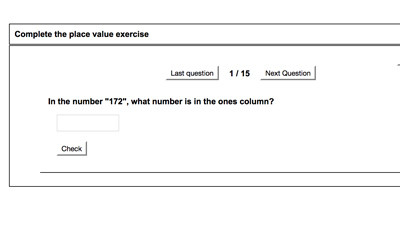
2.NBT.A.1 - Grade 2 Common Core - Place Value - Identifying the Values of Ones, Tens, and Hundreds
Description: This activity requires students to match the identify the value of a digit in a number. For example, "How many hundreds are in 587?"
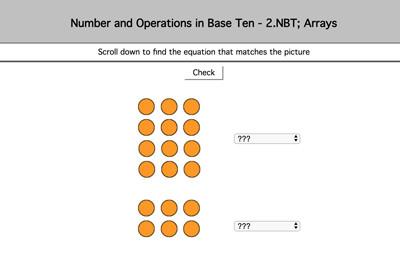
2.NBT.A.2 - Skip Counting
Description: This online activity requires students to skip count by 2's, 5's, 10's, and others
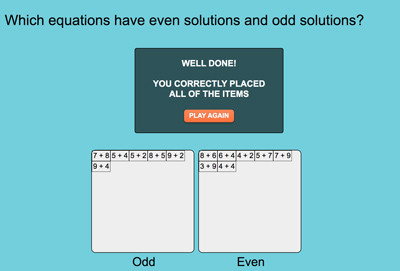
2.NBT.A.3 - Do the Words Match the Numbers?
Description: This online activity requires students to determine whether or not the words match the number. For example, does six hundred fifty-five = 655?
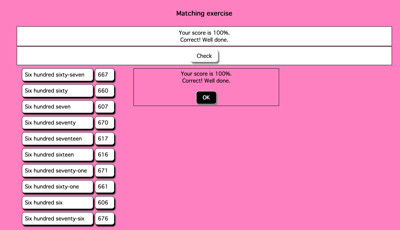
2.NBT.A.3 - Close Numbers - Drag and Drop the Words to Their Numbers
Description: This exercise requires students to match the words with their correct numbers. In this example, all of the numbers are closely related. For example, "six hundred six, six hundred sixty, six hundred sixteen." Students must differentiate between closely related numbers that sound and look alike. Great practice!
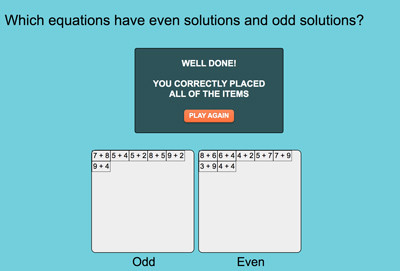
2.NBT.A.4 - Are the Various Numbers Less than or Greater than 500?
Description: This exercise requires students to drag and drop numbers to two containers. One that is greater than 500 and one that is less than 500.
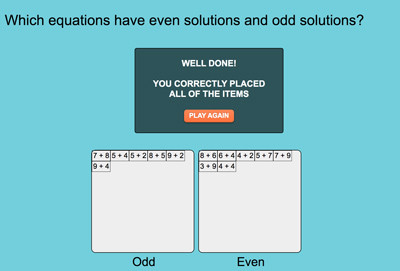
2.NBT.A.4 - Are the Expressions with Greater Than or Less Than True or False?
Description: This exercise requires students to determine whether the expressions are true or false? For example, 714 > 741 or 534 < 543?
2.NBT.B.5 - Adding Two-digit Numbers Without Regrouping
Description: This simple exercise requires students to find the sums of two numbers without using regrouping.
2.NBT.B.5 - Adding Two-digit Numbers and One-Digit Numbers with Regrouping
Description: This simple exercise requires students to find the sums of a two-digit number and a one-digit number with regrouping (e.g. 45 + 7)
2.NBT.B.5 - Adding Two-digit Numbers With Regrouping
Description: This simple exercise requires students to find the sums of two numbers using regrouping.
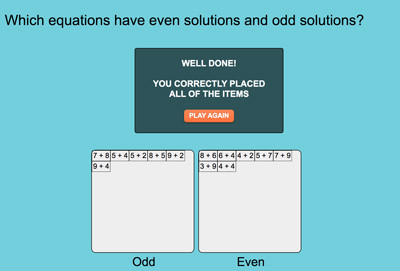
2.NBT.B.5 - To Regroup or Not to Regroup?
Description: This activity requires students to simply determine whether regrouping is required in the addition problems.
2.NBT.B.5 - Subtracting Two-Digit Numbers with Regrouping
Description: This activity requires students to use regrouping to find the differences between two two-digit numbers.
2.NBT.B.5 - Subtracting Two-Digit Numbers Without Regrouping
Description: This activity requires students to find the differences between two two-digit numbers (no regrouping).
2.NBT.B.6 - Adding Three Two-Digit Numbers
Description: This activity requires students to add three two-digit numbers both with and without regrouping.
2.NBT.B.6 - Adding Four Two-Digit Numbers
Description: This activity requires students to add three four-digit numbers (with a sum of less than 100) both with and without regrouping.
2.NBT.B.7 - Adding Three-Digit Numbers
Description: This activity requires students to add two three-digit numbers (463 + 378).
2.NBT.B.7 - Subtracting Three-Digit Numbers
Description: This activity requires students to add subtract three-digit numbers (415 - 246)
2.NBT.B.7 - Adding Two and Three-Digit Numbers Using an In/Out Chart
Description: This activity requires students to follow the rules of an in/out chart to complete the addition problems.
2.NBT.B.8 - Subtracting Multiples of Ten From Three-Digit Numbers
Description: This activity requires students to subtract multiples of ten from three-digit numbers. For example, 170 - 60 or 420 - 150.
2.NBT.B.8 - Adding Multiples of Ten To Three-Digit Numbers
Description: This activity requires students to add multiples of ten to three-digit numbers. For example, 170 + 60 or 420 + 150.
2.NBT.B.9 - Number Association in Equations
Description: This activity requires students to find the number missing in three-way number association. For example, 7, 8, ?
2.NBT.B.9 - Fact Families in Addition and Subtraction
Description: This activity requires students to find the number missing fact in a fact family. For example, 6 + 4 = 10, 4 + 6 = 10, 10 - 4 = 6, and....
2.NBT.B.9 - What is the "Intruder" Number in the Number Association?
Description: This activity requires students to find the "intruder" amongst four associated numbers. For example in the set 7, 15, 4, 8, "4" would be the intruder number because 7, 15, and 8 can be used to form facts together. 4 cannot be combined with two other numbers in the set to produce any facts.
2.MD.A.1 - Measuring Using a Standard Ruler to measure to the inch and half-inch.
Description: This activity requires students to measure to the nearest inch or half-inch with a provided standard ruler.
2.MD.A.1 - Measuring Using a Metric Ruler to measure to the centimeter and half-centimeter.
Description: This activity requires students to measure to the nearest centimeter or half-centimeter using a metric ruler.
2.MD.A.2 - Inches, Feet, or Yards Drag and Drop
Description: This activity requires students to drag and drop the items to their correct container with the label of the best way to measure each. For example, an airport runway would best be measured in yards, whereas a finger would best be measured in inches.
2.MD.A.3 - What is the Best Estimate?
Description: This activity requires students to determine the best estimate in standard length or height for a variety of things. For example, is a bus 35 feet long or 35 yards long?
2.MD.A.3 - Estimating Line Lengths in Metric Units
Description: This activity requires students to use estimation to determine the lengths of lines in metric units.
2.MD.A.4 - Word Problems with Metric Units of Length
Description: This activity requires students to solve word problems with metric units of length.
2.MD.B.6 - Understanding a Number Line from 1-100
Description: This activity requires students to identify the value of different stars on a number line.
2.MD.B.6 - Addition and Subtraction Operations on the Number Line
Description: This activity requires students to identify the value of different stars on a number line and to perform addition and subtraction operations based on those values.
2.MD.B.6 - Using < and > to compare values on a number line
Description: This activity requires students to identify the value of different stars on a number line and to compare their values using <, and >.
2.MD.C.8 - Working with Pennies
Description: This activity requires students to count pennies and total the amount of money.
2.MD.C.8 - Working with Nickels and Pennies
Description: This activity requires students to count nickels and pennies and total the amount of money.
2.MD.C.8 - Working with Nickels
Description: This activity requires students to count nickels and total the amount of money.
2.MD.C.8 - Working with Pennies, Nickels, and Dimes
Description: This activity requires students to count pennies, nickels, and dimes, and total the amount of money.
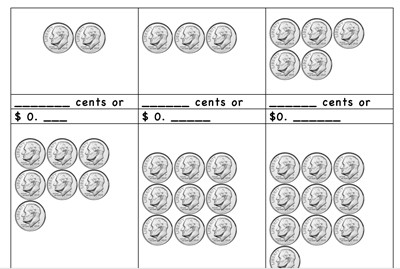
2.MD.C.8 - Working with Dimes
Description: This activity requires students to count dimes and total the amount of money.
2.MD.C.8 - Working with Quarters
Description: This activity requires students to count quarters and total the amount of money.
2.MD.C.8 - Working with Coins and Currency
Description: This activity requires students to calculate money amounts using coins and currency.
2.MD.C.8 - Making Change from a Dollar
Description: This activity requires students to make change from $1.00
2.MD.C.8 - Word Problems with Money Amounts
Description: This activity requires students to find solutions for word problems with money amounts.
2.MD.D.9 - Pictograms
Description: This activity requires students to answer questions associated with a pictogram.
2.MD.D.9 - Tally Charts
Description: This activity requires students to answer questions associated with a tally chart.
2.MD.D.10 - Introduction to Bar Graphs
Description: This activity requires students to use data from a bar graph to answer questions.
2.MD.D.10 - Fun with Bar Graphs: Favorite Ice Cream Flavors
Description: This activity requires students to read data from bar graphs to answer questions about favorite ice cream flavors.
2.MD.D.10 - Bar Graphs: Variations of the Y-Axis
Description: This activity requires students to interpret bar graphs in which the Y-Axis changes to different intervals.
2.MD.D.10 -Bar Graphs: The Number of Siblings Per Student in a Classroom
Description: This activity requires students to read data from a bar graph to answer questions about the number of siblings per student in a fictional classroom.
2.G.1 - Identifying Shapes
Description: This activity requires students to identify different shapes.
2.G.1 - Identifying Attributes of Basic Shapes
Description: This activity requires students to identify attributes of different shapes.
2.G.1 -Vertices, Edges, and Faces
Description: This activity requires students to identify the amount of vertices, edges, or faces on each of the shapes.
2.G.2 - Area Units
Description: This activity requires students to count area units.
2.G.3 - Introduction to Halves and Fourths
Description: This activity requires students to identify fractions that show 1/2 or 1/4.
2.G.3 - Basic Fraction Identification
Description: This activity requires students to identify fractions based on the pictures shown.
2.G.3 - Is the Fraction Greater than or Less than 1/2?
Description: This activity requires students to rag and drop the fractions into their correct containers based on whether or not each is larger than 1/2.
Advertisement