Printer
Colonial printers produced newspapers, books, pamphlets, and other publications. Their work helped spread news and ideas throughout the colonies.
The Colonial Print Shop
Colonial printers printed books, newspapers, pamphlets and other publications. Their shops sometimes served as mail centers as well. Printers who printed newspapers bought their paper from a paper mill and made the ink in their shops. Paper was made from linen and cloth and ink was made from tannin, iron sulfate, gum, and water.
Setting the Type
Printing a publication such as a newspaper was a comprehensive and complicated task. First, the type was set. A type was a single piece of metal with a letter, number, or point of punctuation. Setting the type was a taxing, cumbersome task. A single page of a colonial newspaper could take up to 25 hours of labor to produce. The type setting process was done by an employee or apprentice of the printer known as the compositor.
How the Printing Press Worked
An inking pad or “beater” was used to spread the ink over the type. The type would be arranged and held with an apparatus called a composing stick. The stone was a large flat surface that held the work to be printed, and the press was the machine that transferred the arranged lettering to a page. The press itself functioned by squeezing the paper against the arranged type with about 200 pounds of pressure to ensure the ink was deposited boldly and evenly on the paper. The paper was then set aside to dry before the other side was printed.
Benjamin Franklin: Famous Colonial Printer
Among the most famous of colonial printers was Benjamin Franklin, who published newspapers and books from his printing press in Philadelphia. One of Franklin’s most famous publications was called Poor Richard’s Almanac, a book of predictions, information, and advice, in which popular sayings were first published such as “a penny saved is a penny earned” and “three may keep a secret if two of them are dead.”
Watch a Colonial Printing Press Demonstration
Colonial-era Printing Press Demonstration
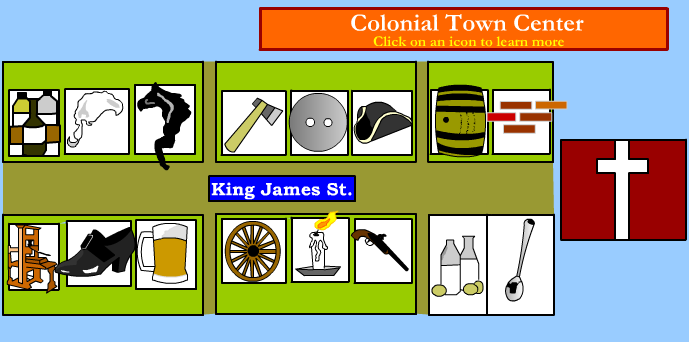
Explore the Colonial Town
Click a shop or building on the map to learn about another colonial trade.