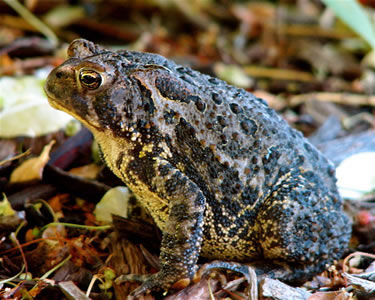
Description: The American Toad is the
most widespread toad species found in the United States.
Measuring up to three inches in length, the American
Toad is greenish, brownish, or olive in coloration, with
short legs and thick skin covered with yellowish or brownish
warts. The color of the toad changes depending on temperature,
humidity and stress levels. The underparts are whitish
or yellowish. Males can be distinguished from females
by their darker throats and their smaller size. The skin
of the American Toad produces secretions that prove toxic
to predators and possibly beneficial to the study of
medicine. They hibernate during the winter.
Diet: American Toads are prodigious
consumers of insects. They also east earthworms, slugs
and other invertebrates. The American Toad uses its long,
sticky tongue to snatch prey. American Toads can consume
up to 1,000 insects per day. Its diet makes it beneficial
to farmers and gardeners trying to eliminate harmful
insects. Interestingly, toad tadpoles are purely herbivorous.
Habitat/Range: The American Toad is found throughout
most of eastern Canada and the United States, except
for potions of the deep south. They prefer areas with
permanent water sources such as ponds or marshes, but
can also be found in gardens, lawns, grasslands, and
areas with dense vegetation. During the day, they often
hide in wood piles, under porches, or in the woods.
Breeding: Toads breed in March or April. Females
choose their mates based on the quality of their breeding
call and their territory. Female toads lay between 4,000
and 8,000 eggs in a raft of jelly on the surface of the
water. The eggs are positioned in two parallel lines
that can extend to 60 feet in length. The eggs hatch
in 3-12 days. The tadpoles develop into toads within
70 days, but sometimes within 40 days. Most toads will
only live a year or two in the wild as many die as tadpoles
and others are consumed by predators such as snakes.
|