The ivory-billed woodpecker, known in birdwatching circles as the "Lord God bird," or "holy grail bird" was the largest woodpecker found in the United States. Its bright red crest, large white wing patches, ivory-white bill, and hawk-like size were said to evoke the phrase "Lord God!" among birders.
In the early 1900's, populations of ivory-billed woodpeckers crashed after the bottomland forests of the deep south were cleared away for agriculture. The woodpecker, which required huge tracts of unspoiled land, could not adapt. By the 1930's, only a scattered few were left, and by the middle of the century, it was thought to be extinct, though it wasn't added to the endangered species list until 1967. There were many unconfirmed sightings throughout the south during the next decades, but none were accompanied with a photograph or recording.
Then on April 28, 2005, a group of wildlife scientists and biologists affiliated with the Nature Conservancy and the Cornell University Department of Ornithology confirmed that at least one ivory-billed woodpecker had been sighted in the Big Woods of central Arkansas. The investigation was undertaken after several reputable wildlife watchers had claimed to observe the birds in flight over the Cache River and White River National Wildlife Refuges. The observers were so overjoyed by the sighting, that they reportedly broke down in tears. The physical evidence was based on a sketchy photograph and several recordings. The findings were kept secret for over a year so that measures could be taken to purchase and protect the land.
Upon word of the discovery, birdwatchers across the world rejoiced. The story made national headlines and was featured on the front page of major newspapers throughout the United States. People were overjoyed that a species previously thought of as extinct may still persist deep in a wilderness rarely penetrated by human beings. The town of Brinkley, near where the ivory-billed woodpecker was observed, even conducted an ivory-billed woodpecker festival. Today, much of Brinkley is decorated by hand-made ivory-billed woodpecker items.
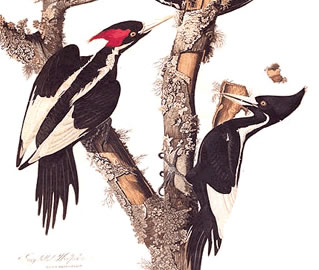
The search for conclusive evidence of the ivory-billed woodpecker's existence continues today. Recently, scientists searching for the birds in the Florida panhandle claim to have made 13 ivory-billed woodpecker sightings. Unfortunately, the scientists were unable to record their findings on film. Although dozens of scientists have claimed the existence of the ivory-billed woodpecker to be true, many people are not convinced. There remains no indisputable physical evidence. The photograph is sketchy at best, and many of the recordings and other evidence could be attributed to the similar pileated woodpecker. Nevertheless, there is currently a $10,000 reward for anyone who can lead a certified wildlife biologists to an active ivory-billed woodpecker site.
Today, the search continues. Scientists are currently searching through the swampy woods of Texas, Louisiana, Arkansas, Mississippi and Florida. |