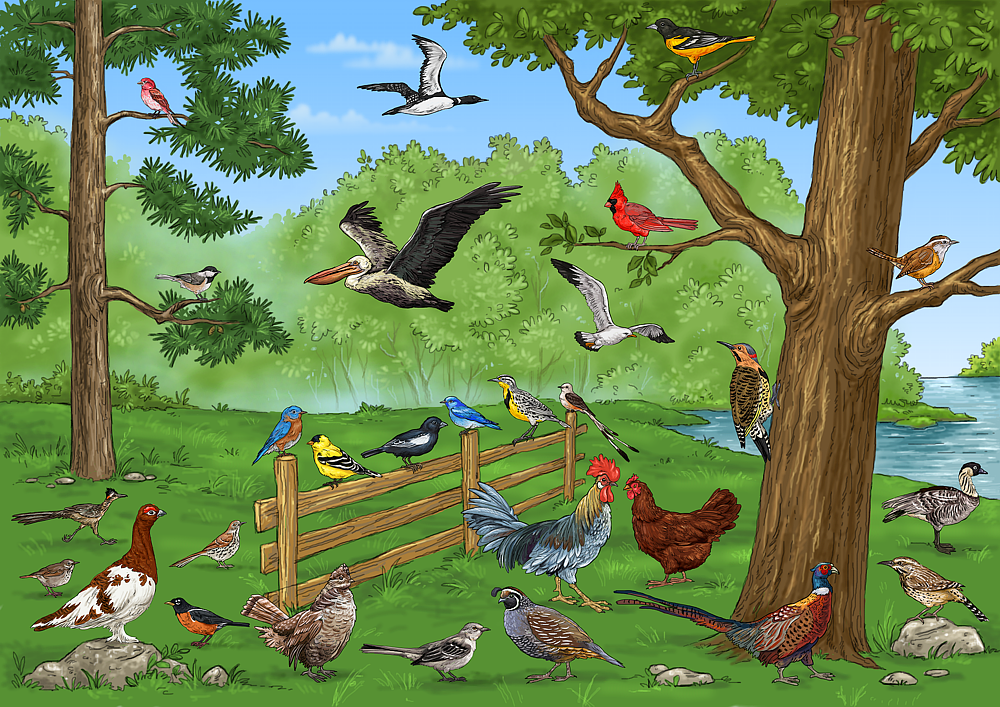
American State Birds - Click on a bird to learn more
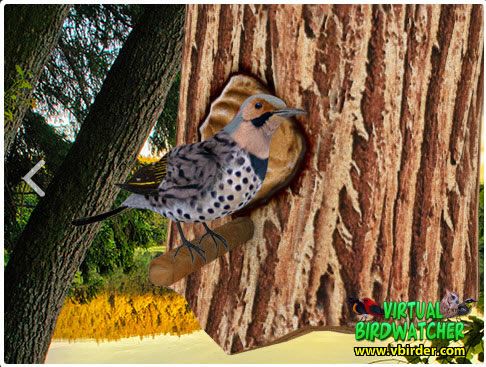
Northern Flicker (Yellowhammer)
State bird of: Alabama
Description
The Northern Flicker (commonly called Yellowhammer) appears different in the eastern United States than in the western United States. The east and midwest have the Yellow-Shafted Flicker and the west has the Red-Shafted Flicker. The Gilded Flicker of the southwest is very similar to the Red-Shafted Flicker, but is considered a separate species. In locations where the ranges of the Yellow-Shafted and Red-Shafted Flicker overlap, the variations interbreed. In other words, in parts of the western Great Plains, where the Yellow-Shafted Flicker lives with the Red-Shafted Flicker, a male Yellow-Shafted may take a female Red-Shafted as a mate, or vice versa.
The Northern Flicker is a large woodpecker, measuring about 11 inches in length. The male yellow-shafted has a brown back and wings speckled with black, spotted underparts and a buff colored face. The male also has a gray cap and nape, with a red section on the neck. The breast has a large crescent-shaped black marking. In flight, Yellow-Shafted Flickers have bright yellow wing shafts, and a noticeable white rump. As is the case with all Flickers, males have a “mustache” extending from the bill, whereas females do not. The male Yellow Shafted Flicker has a black mustache.
The Red-Shafted Flicker is the same size, but has a gray face, a brown cap and nape, and males have a red mustache extending from the bill. Red-Shafted Flickers show bright red wing shafts in flight.
The Gilded Flicker is somewhat of a combination of the two. It is identical to the Red-Shafted Flicker but has bright yellow wing shafts like the Yellow-Shafted Flicker, unlike the Red-Shafted Flicker’s red wing shafts.
Diet
Range and Habitat
Status