American Revolution • Literature • African American History • Women in History
EasierStandard
Reading level: Standard • Click highlighted vocabulary for a definition.
Early Life
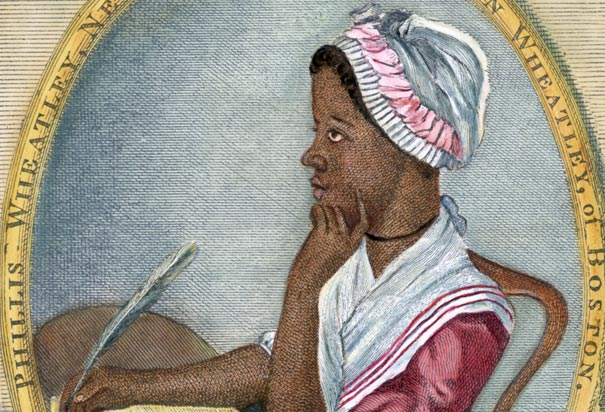
Phillis Wheatley was born in Gambia on May 8, 1753. When she was 7 or 8, she was sold as a slave to John and Susanna Wheatley of Boston. She was named after the ship that brought her to America, the Phillis. The Poetry Foundation describes her sale below:
The Poetry Foundation Account
In August 1761: "in want of a domestic," Susanna Wheatley, ... purchased "a slender, frail female child ... for a trifle"... The captain of the slave ship believed that the waif was terminally ill, and he wanted ... at least a small profit before she died. ...The family surmised the girl - who was "of slender frame and evidently suffering from a change of climate," nearly naked, with "no other covering than a quantity of dirty carpet about her" - to be "about seven years old ... from the circumstances of shedding her front teeth."
The 12 Year-old Poet
Phillis was very intelligent. The Wheatley family taught her to read and write, and encouraged her to write poetry. Her first poem "On Messrs. Hussey and Coffin" was published when she was only twelve. In 1770, An Elegiac Poem, on the Death of that Celebrated Divine, and Eminent Servant of Jesus Christ, the Reverend and Learned George Whitefield made her famous. It was published in Boston, Newport, and Philadelphia.
Short-lived Fame
When she was eighteen, Phillis and Mrs. Wheatley tried to sell a collection containing twenty-eight of her poems. Colonists did not want to buy poetry written by an African. Mrs. Wheatley wrote to England to ask Selina Hastings, Countess of Huntingdon, for help. The countess was a wealthy supporter of evangelical and abolitionist (anti-slavery) causes. She had Poems on Various Subjects, Religious and Moral published in England in 1773. This book made Phillis famous in England and the thirteen colonies. In 1775, Phillis wrote a poem for George Washington, who praised her work. They met in 1776. Phillis supported independence for the colonies during the Revolutionary War. She became the first African American and the first slave in the United States to publish a book.
Phillis Wheatley's Work
A Short Life
After her master died, Phillis was emancipated (freed). She married John Peters, a free black man, in 1778. She and her husband lost two children as infants. John would be imprisoned for debt in 1784. Phillis, who suffered from respiratory ailments for most of her life, died in December of 1784, and was buried in an unmarked grave.
Discussion Questions
How did Wheatley’s education create opportunities for her while also existing within the injustice of her enslavement?
Why was publication in England important to Wheatley’s literary career?
What tension can you identify between Wheatley’s support for American independence and her own experience of slavery?
Why might Wheatley’s difficult later years complicate the idea that fame automatically brought security or equality?
🔎 Phillis Wheatley Scavenger Hunt
Early Life
Phillis Wheatley was born in Gambia on May 8, 1753. When she was 7 or 8, she was sold as a slave to John and Susanna Wheatley of Boston. She was named after the ship that brought her to America, the Phillis. The Poetry Foundation describes her sale below:
The Poetry Foundation Account
In August 1761: "in want of a domestic," Susanna Wheatley, ... purchased "a slender, frail female child ... for a trifle"... The captain of the slave ship believed that the waif was terminally ill, and he wanted ... at least a small profit before she died. ...The family surmised the girl - who was "of slender frame and evidently suffering from a change of climate," nearly naked, with "no other covering than a quantity of dirty carpet about her" - to be "about seven years old ... from the circumstances of shedding her front teeth."
The 12 Year-old Poet
Phillis was very intelligent. The Wheatley family taught her to read and write, and encouraged her to write poetry. Her first poem "On Messrs. Hussey and Coffin" was published when she was only twelve. In 1770, An Elegiac Poem, on the Death of that Celebrated Divine, and Eminent Servant of Jesus Christ, the Reverend and Learned George Whitefield made her famous. It was published in Boston, Newport, and Philadelphia.
Short-lived Fame
When she was eighteen, Phillis and Mrs. Wheatley tried to sell a collection containing twenty-eight of her poems. Colonists did not want to buy poetry written by an African. Mrs. Wheatley wrote to England to ask Selina Hastings, Countess of Huntingdon, for help. The countess was a wealthy supporter of evangelical and abolitionist (anti-slavery) causes. She had Poems on Various Subjects, Religious and Moral published in England in 1773. This book made Phillis famous in England and the thirteen colonies. In 1775, Phillis wrote a poem for George Washington, who praised her work. They met in 1776. Phillis supported independence for the colonies during the Revolutionary War. She became the first African American and the first slave in the United States to publish a book.
Phillis Wheatley's Work
A Short Life
After her master died, Phillis was emancipated (freed). She married John Peters, a free black man, in 1778. She and her husband lost two children as infants. John would be imprisoned for debt in 1784. Phillis, who suffered from respiratory ailments for most of her life, died in December of 1784, and was buried in an unmarked grave.
Early Life
Phillis Wheatley was born in West Africa around 1753. As a child, she was kidnapped and transported across the Atlantic on a slave ship. In 1761, John and Susanna Wheatley of Boston purchased her and named her Phillis after the ship that carried her to North America.
A Remarkable Education
The Wheatley household taught Phillis to read and write. She studied literature, religion, and classical subjects and began writing poetry while still young. Her writing ability attracted attention in Boston and beyond.
Becoming a Published Poet
Wheatley’s poetry about the minister George Whitefield brought her wider recognition. In 1773, Poems on Various Subjects, Religious and Moral was published in London. Its publication made Wheatley one of the best-known Black writers of the colonial era.
Revolution and Washington
Wheatley wrote about events and ideas connected with the American Revolution. She sent a poem to George Washington in 1775 praising him and the American cause. Washington thanked her, and evidence indicates that they met in Cambridge in 1776.
Freedom and Later Life
Wheatley gained her freedom in the 1770s and married John Peters in 1778. Her later years were difficult. She struggled financially and died in Boston in December 1784 at about age thirty-one. Her poetry remains important to the history of American literature.