American Revolution • Women in History • American Flag
EasierStandard
Reading level: Standard • Click highlighted vocabulary for a definition.
Early Years and Marriage
Betsy Ross is thought to have sewn the first American flag. Born the 8th of 17 children to a Quaker family, Betsy learned to read, write, and sew at an early age. While working at her job as an upholstering apprentice, Betsy fell in love with John Ross, another apprentice. Because Betsy was a Quaker and John was an Episcopal, Betsy's family disapproved of the marriage and the Quaker church disowned the couple. Interestingly, the couple was married by William Franklin, the son of Benjamin Franklin.
Betsy's Famous Flag
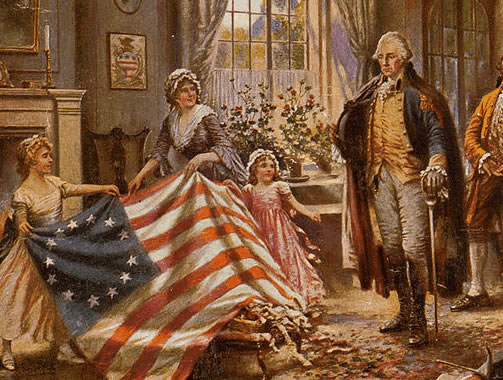
In 1775, two years after the marriage, the Ross' started their own upholstery business. With the start of the Revolutionary War, John joined the Pennsylvania Militia and was killed in 1776 by a gunpowder explosion. Betsy took over the business. According to legend (which has been proven to be not entirely true), Betsy received a visit from George Washington (whom Betsy attended church with), Robert Morris, and George Ross who presented her with a sketched image of a flag with six pointed stars. Betsy suggested five pointed stars and sewed it in her back parlor. Her flag first flew with the reading of the Declaration of Independence at Independence Hall on July 8, 1776.
The Betsy Ross Flag
Discussion Questions
How did Betsy Ross’s early training help her become an independent business owner?
Why did Betsy and John Ross’s marriage create conflict with her Quaker family and community?
What parts of the famous flag story are presented as legend rather than firmly documented fact?
Why does the fact that the Ross flag story was publicly recorded decades after the Revolution matter to historians?
🔎 Betsy Ross Scavenger Hunt
Early Years and Marriage
Betsy Ross is thought to have sewn the first American flag. Born the 8th of 17 children to a Quaker family, Betsy learned to read, write, and sew at an early age. While working at her job as an upholstering apprentice, Betsy fell in love with John Ross, another apprentice. Because Betsy was a Quaker and John was an Episcopal, Betsy's family disapproved of the marriage and the Quaker church disowned the couple. Interestingly, the couple was married by William Franklin, the son of Benjamin Franklin.
Betsy's Famous Flag
In 1775, two years after the marriage, the Ross' started their own upholstery business. With the start of the Revolutionary War, John joined the Pennsylvania Militia and was killed in 1776 by a gunpowder explosion. Betsy took over the business. According to legend (which has been proven to be not entirely true), Betsy received a visit from George Washington (whom Betsy attended church with), Robert Morris, and George Ross who presented her with a sketched image of a flag with six pointed stars. Betsy suggested five pointed stars and sewed it in her back parlor. Her flag first flew with the reading of the Declaration of Independence at Independence Hall on July 8, 1776.
The Betsy Ross Flag
Early Years
Betsy Ross was born Elizabeth Griscom in Philadelphia in 1752. She grew up in a Quaker family and learned sewing and upholstery. She later married John Ross and worked as an upholsterer in Philadelphia.
Revolutionary War
John Ross died during the Revolutionary War. Betsy continued her upholstery business and did work connected with flags. Women like Ross were part of Philadelphia’s community of skilled flag makers.
The Famous Flag Story
A famous family story says that George Washington, Robert Morris, and George Ross asked Betsy to make a flag and that she suggested using five-pointed stars. The story was publicly presented by her grandson William Canby in 1870, many decades after the Revolution. Historians have not found contemporary records proving that Betsy designed or sewed the first United States flag.
Betsy Ross in American Memory
The story became widely popular in the late nineteenth and twentieth centuries. Betsy Ross remains strongly associated with the early American flag, even though historians distinguish the famous family tradition from facts that can be documented from the Revolutionary era.