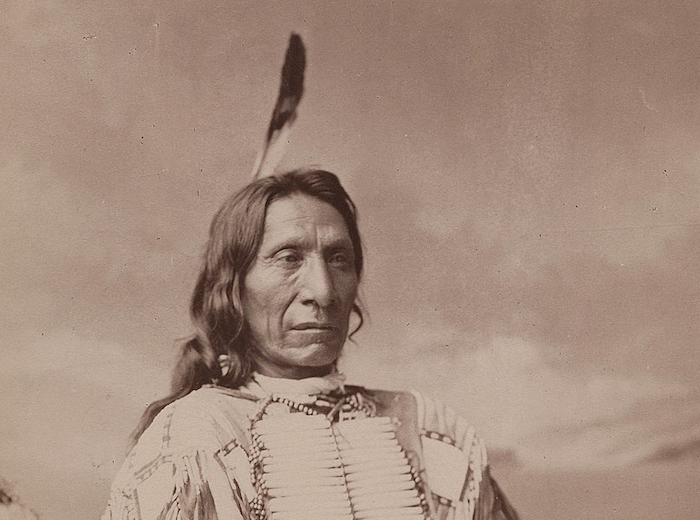
Early Life and Background
Red Cloud was born around 1822 near the Platte River in what is now Nebraska. He belonged to the Oglala Lakota, one of the seven divisions of the Lakota. From a young age, Red Cloud learned the skills of hunting, leadership, and warfare. His people relied heavily on buffalo for food, clothing, shelter, tools, and other necessities. As he matured, he became known as an important warrior and leader.
Red Cloud’s War
In the 1860s, increasing numbers of travelers used the Bozeman Trail, which crossed the Powder River country on the way to the Montana gold fields. The United States began building forts along the route. Lakota, Northern Cheyenne, and Northern Arapaho people resisted this intrusion into hunting grounds they used and defended. Red Cloud became a leading figure in the conflict that became known as Red Cloud’s War, fought from 1866 to 1868.
Native warriors repeatedly attacked soldiers, forts, and travelers along the route. In December 1866, a force led by Captain William J. Fetterman was defeated near Fort Phil Kearny. Continued resistance made the Bozeman Trail and the forts difficult for the United States to maintain. Peace negotiations eventually produced the Treaty of Fort Laramie of 1868. Under the treaty, the United States agreed to abandon the forts along the Bozeman Trail. The treaty also established the Great Sioux Reservation west of the Missouri River in present-day South Dakota and recognized the Powder River country as unceded Indian territory reserved for Native use.
Diplomacy and Washington, D.C.
After the war, Red Cloud increasingly used diplomacy to defend Lakota interests. In 1870, he traveled to Washington, D.C., where he met President Ulysses S. Grant and other government officials. Red Cloud challenged the government's interpretation of the 1868 treaty and argued for his people's rights and supplies promised to them. He later made additional trips to Washington.
Red Cloud did not join the large-scale fighting of the Great Sioux War of 1876-77. Instead, he continued negotiating with U.S. officials while opposing policies that threatened Lakota land and independence. His approach did not mean that he accepted every government demand. He repeatedly objected to efforts to reduce Lakota lands and pressed officials to fulfill treaty obligations.
The Black Hills
The discovery of gold in the Black Hills in the 1870s created another major crisis. The Black Hills were within the Great Sioux Reservation established by the 1868 treaty, but miners entered the region in growing numbers. The U.S. government attempted to purchase the Black Hills. When negotiations failed and conflict expanded, Congress passed legislation in 1877 that took the Black Hills and other lands from the Sioux. The loss became a lasting source of dispute between the Sioux nations and the United States.
Life at Pine Ridge
Red Cloud eventually lived at the Red Cloud Agency, which was moved several times before becoming associated with the Pine Ridge Reservation in present-day South Dakota. He continued speaking with government officials, missionaries, journalists, and visitors about Lakota concerns. As federal policies increasingly restricted Native life, Lakota communities faced shrinking lands, dependence on government rations, pressure to adopt farming, and attempts to suppress traditional culture and religion.
Red Cloud remained an influential Oglala leader, although leadership within Lakota communities was complex and other leaders sometimes disagreed with his decisions. His long life stretched across a period of enormous change—from the era when Lakota people exercised great power across the northern Plains to the reservation era of the late nineteenth and early twentieth centuries.
Legacy and Death
Red Cloud died in 1909 at Pine Ridge in South Dakota. He is remembered for his leadership during Red Cloud’s War and for the decades he spent negotiating with the United States afterward. His life illustrates both armed resistance and diplomacy as strategies Native leaders used while trying to protect their people, lands, treaty rights, and ways of life during a period of rapid American expansion.
Five Interesting Facts
- Red Cloud was one of the best-known Oglala Lakota leaders of the nineteenth century.
- Red Cloud’s War helped force the United States to abandon the Bozeman Trail forts under the 1868 Treaty of Fort Laramie.
- He traveled to Washington, D.C., several times to negotiate with federal officials.
- He lived through the transition from the powerful Plains buffalo-hunting era to reservation life.
- Red Cloud Indian School, now Red Cloud School, at Pine Ridge was named for him.
Timeline
- c. 1822 – Red Cloud is born near the Platte River.
- 1866–1868 – Red Cloud’s War is fought in the Powder River region.
- 1868 – The Treaty of Fort Laramie is signed.
- 1870 – Red Cloud travels to Washington, D.C., and meets President Ulysses S. Grant.
- 1877 – The U.S. government takes the Black Hills and other lands despite provisions of the 1868 treaty.
- 1909 – Red Cloud dies at Pine Ridge in South Dakota.
Discussion Questions
- Why did the Bozeman Trail and the forts built along it lead to Red Cloud’s War?
- How did the Treaty of Fort Laramie of 1868 change the situation in the Powder River country?
- Why did Red Cloud increasingly use diplomacy after the war, and what did he try to accomplish in Washington?
- How did the loss of the Black Hills show the limits of the protections promised in the 1868 treaty?