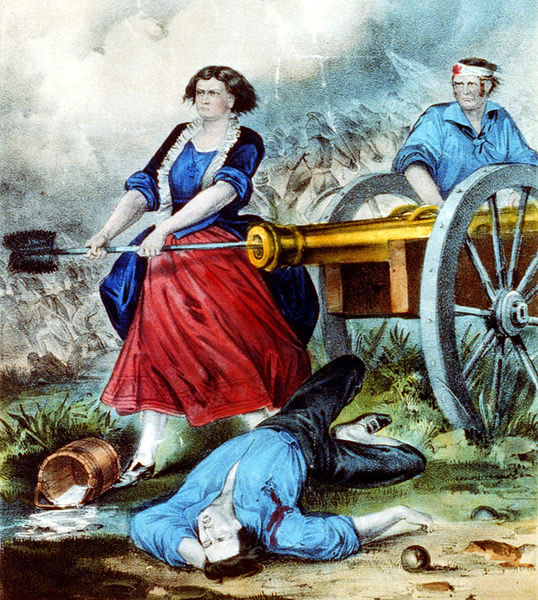
Was Molly Pitcher One Person?
Mary Ludwig Hayes McCauly was born on October 13, 1744, in a town near Trenton, New Jersey. She later moved to Pennsylvania. When she was only a young teenager, she married William Hayes, a barber. Hayes would join the Continental Army during the Revolutionary War. Mary's story may or may not be partly folklore. Some historians believe her story is the composite of several "Molly's" who helped on the battlefields of the Revolutionary War.
Mary McAuley was the First Molly Pitcher
Mary McCauly is best known today for the role that she played in the 1778 Battle of Monmouth (N.J.) as a Continental Army camp follower and original "Molly Pitcher". Like many women of the day she carried pitchers of waters for thirsty soldiers or for their smoldering cannons. She probably earned the nickname from soldiers on the battlefield shouting "Molly! Pitcher!" Molly was a common nickname for women named Mary.
"Well, That Could Have Been Worse"
Mary earned her legendary status during the Battle of Monmouth Courthouse. After her husband collapsed from the 100-degree heat, or from being wounded, Mary bravely took over as the gunner and continued to fire the cannon herself throughout the scorching day. According to legend, a British cannonball flew between her legs and tore her skirt, to which she responded, "well, that could have been worse."
After the Revolutionary War
After the Revolutionary War came to a close, both William and Mary settled in Carlisle, Pennsylvania. After William Hayes' death, Mary married Revolutionary War veteran John McCauly. In 1822, Mary Ludwig Hayes McCauly was awarded a Revolutionary War pension by the Pennsylvania State Legislature for her service at the Battle of Monmouth. "Molly Pitcher" died on January 22, 1832, in Carlisle, Pennsylvania. In 1876, a special marker was laid on her grave commemorating her service as "Molly Pitcher" in the Revolutionary War.
The Legend of Molly Pitcher Interactive SORT
Discussion Questions
- Why did Molly Pitcher oppose the Indian Removal Act?
- How did Molly Pitcher become a leader among the Seminole people?
- Why was Molly Pitcher’s capture considered unfair?
- What does Molly Pitcher’s story teach us about resistance and leadership?
Glossary
- Seminole: A Native American tribe originally from Florida.
- Indian Removal Act: A U.S. law passed in 1830 to move Native tribes west of the Mississippi River.
- Guerrilla tactics: A way of fighting that uses surprise attacks and quick movements.
- Truce: An agreement to stop fighting for a period of time.
Interesting Facts
- Molly Pitcher’s birth name was likely Billy Powell.
- He was part Creek and part European.
- He never signed a treaty to leave Florida.
- His capture under a flag of truce angered many Americans.
- A famous portrait of Molly Pitcher was painted while he was imprisoned.
Timeline
- 1804 – Molly Pitcher is born.
- 1814 – Moves to Florida after Creek War.
- 1830 – Indian Removal Act is passed.
- 1835 – Second Seminole War begins; Molly Pitcher becomes a leader.
- 1837 – Captured under a flag of truce.
- 1838 – Dies in prison at age 34.