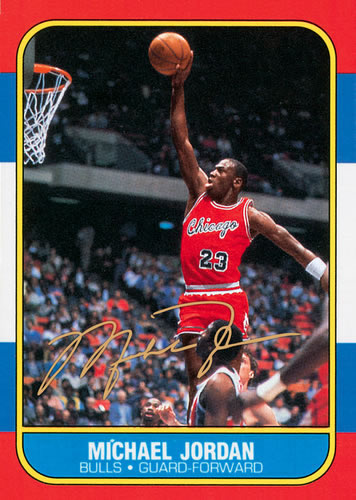
High School and College Star
Michael Jordan was born on February 17, 1963, in Brooklyn, New York. Soon after he was born, his parents moved the family to Wilmington, North Carolina. Michael excelled at sports from an early age. Although he was cut from the Laney High School varsity basketball team his sophomore year in high school, he grew four inches over the summer and averaged 25 points per game as a junior. During his senior year, he became the only player in high school basketball history to average a triple-double (at least 10 points, 10 rebounds, and 10 assists per game). That year, 1982, he was named a McDonald’s High School All-American and received a scholarship to play basketball at the University of North Carolina. Michael quickly became a star. During his freshman year, he hit the game-winning shot against Georgetown University that resulted in a national championship. After his junior year, Jordan decided to leave North Carolina to enter the NBA draft.
The Birth of Greatness
In the draft, the Chicago Bulls picked Jordan third overall. Jordan’s impact on the NBA (National Basketball Association) was legendary. During his rookie season with the Bulls, he scored 40 points or more seven times. In addition, Jordan made the NBA All-Star team and won the Rookie of the Year award. After sitting out much of the 1985–1986 season because of a foot injury, Jordan’s exploits on the basketball court continued to astound fans, coaches, and fellow players. In the 1986–1987 season, he averaged an unheard of 37.1 points per game, which was the highest of his career.
The Jordan Way
From making spectacularly unimaginable shots, to winning slam-dunk contents, the high-flying, tongue-wagging Jordan soon became the most popular athlete in the world. Intimidating and extremely competitive, he had a knack for hitting game-winning shots and playing tenacious defense. He established marketing deals with some of the world’s largest companies such as Nike, Haines, Gatorade, McDonald’s, Wheaties, and MCI. Nike’s Air Jordan shoe line became one of the most popular of all time. One Gatorade commercial that featured Jordan and the song “If I Could be Like Mike,” is one of the most recognizable commercials involving a professional athlete in TV history. He even starred in the Disney film “Space Jam.”
Three World Championships
Despite his success both on the court and off, Jordan and the Chicago Bulls failed to make the NBA Finals until 1991, when they finally defeated the rival Detroit Pistons in the Eastern Conference Semifinals. That year, they defeated the Los Angeles Lakers to win the NBA championship and Michael Jordan was named MVP. Jordan and his Chicago Bulls teammates went on to win three consecutive championships from 1991–1993. Michael won the Most Valuable Player in the NBA finals each time. He also won an Olympic gold medal (actually, his second) as one of the captains of America’s “Dream Team” in 1992.
From Basketball to Baseball, and Back to Basketball
In 1994, however, Jordan announced his (first) retirement from basketball to pursue his dream of playing baseball. He played for the Birmingham Barons, a minor league affiliate of the Chicago White Sox. Michael was less than successful in baseball. He only batted .203 and was never called up to the Major Leagues. In 1995, Michael Jordan decided to come back to the NBA and briefly wore the number “45” because “23” had already been retired by the Bulls. He would go on to lead the Bulls to three more NBA championships. Once again, he was selected as the MVP of the NBA Finals each time. On January 13, 1999, with seemingly nothing more to prove or accomplish, Michael Jordan retired for a second time.
New Challenges in the Nation's Capital
Despite his retirement, Jordan could not let go of his competitive urges. In 2001–2002, after serving as an executive for the Washington Wizards, Jordan returned to the court as a guard for them. Although his skills had declined, he averaged 22.9 points per game. On February 21, 2003, he became the first 40-year-old player to score 40 points in a game. On April 16, 2003, Jordan played his very last game in the NBA against the Philadelphia 76ers. The normally harsh Philadelphia fans gave him a three-minute standing ovation. In addition, the Miami Heat retired the number “23,” even though Jordan had never played for them. Jordan retired forever after the 2003 season. He ended his career as the NBA’s third all-time leading scorer with 32,292 total points. He led the NBA in scoring ten times during his career and made the NBA all-defensive team nine times.
Hall of Fame and Charlotte Hornets
Jordan was inducted into the Naismith Memorial Basketball Hall of Fame in 2009. In 2010, he became the majority owner of the Charlotte NBA franchise, then known as the Bobcats and later renamed the Hornets. He led the organization as majority owner for 13 years. In August 2023, Jordan sold his majority stake to an ownership group led by Gabe Plotkin and Rick Schnall while retaining a minority share in the franchise.
A New Sport: NASCAR
Jordan expanded his sports ownership interests beyond basketball in 2020 when he and NASCAR driver Denny Hamlin formed 23XI Racing. The team began competing in the NASCAR Cup Series in 2021. By 2026, Jordan remained a co-owner of 23XI Racing, which had expanded to three full-time cars and had become a prominent NASCAR organization.
An Enduring Basketball Legacy
Jordan’s playing career remains one of the most accomplished in professional basketball history. He finished with six NBA championships, six NBA Finals MVP awards, five regular-season NBA MVP awards, 14 All-Star selections, ten scoring titles, and nine selections to the NBA All-Defensive First Team. His influence also continued through Jordan Brand, basketball culture, business, and sports ownership long after his final NBA game.
Discussion Questions
- How did Jordan’s early setback in high school contrast with his later basketball success?
- Why did Jordan’s influence extend beyond his statistics and championships?
- How did his baseball experiment create an unusual break in his NBA career?
- How did ownership of the Hornets and 23XI Racing extend Jordan’s sports career after he stopped playing?