Early Life
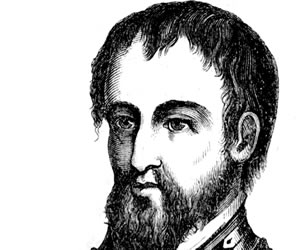
Hernando de Soto was born in Jerez de los Caballeros, Spain, sometime around the year 1500. He was born to a family in Extremadura, a region where opportunities for younger sons of the lesser nobility could be limited. Like many young Spanish men of the time, de Soto sought wealth, status, and military fame in newly conquered lands across the Atlantic.
Glory and Conquest
In 1514, de Soto sailed to the Americas with the expedition of Pedro Arias Dávila, who became governor of Panama, where de Soto participated in Spanish conquest and colonization in Central America. From an early age, de Soto gained a reputation for bravery, intellect, and brutality. In the late 1520s, he took part in expeditions in Central America before joining Francisco Pizarro and his conquest of the Inca Empire in South America. Because de Soto had a major part in the conquest of the Inca Empire, he became fabulously wealthy. Upon his return to Spain, he married Isabel de Bobadilla. De Soto was later made governor of Cuba and received royal authorization to conquer and colonize a large area of the mainland of North America. He chose about 600 men for the voyage from Cuba to the interior of North America. De Soto hoped to find riches and establish Spanish control over new territory.
Into the Southeast in Search of Gold
In May of 1539, de Soto, about 600 men, and more than 200 horses landed on the west coast of Florida, probably near Tampa Bay. He named the surrounding region Espíritu Santo after the Holy Spirit. The expedition then traveled north through the peninsula of Florida, where the Spaniards faced resistance from Native peoples along the way. By 1540, de Soto had reached present-day Georgia and South Carolina in pursuit of riches rumored to exist in the region. Unsuccessful in his attempts to find gold, de Soto continued north into the southern Appalachian region. Once again, there was no gold to be found, and de Soto spent time resting his horses before traveling west and then south again toward the Gulf of Mexico, where supply ships might be reached. While traveling south, de Soto and his men fought the people of the fortified town of Mabila, generally associated with the Mobile people, in present-day Alabama. In the battle, many of de Soto’s men were killed or wounded, and large numbers of Native people died. Despite the Spanish victory, de Soto and his men lost much of their equipment and supplies, and many had become sick or injured. Consequently, de Soto directed his expedition north, and they spent the winter in present-day Mississippi.
Crossing the Mississippi River
After the winter, de Soto’s expedition traveled northwest. In May 1541, Hernando de Soto and his expedition became the first Europeans known to have documented reaching the Mississippi River, although de Soto was not exactly thrilled with the finding. The Mississippi River was a huge, broad river that stood in the way of his expedition. It took several weeks to build boats suitable for crossing the river. Once across, the expedition continued through parts of what are now Arkansas and possibly neighboring areas. They spent the next winter in the region of the Arkansas River. Things began falling apart for de Soto when Juan Ortiz, his faithful interpreter, died. The death of Ortiz made communication with Native peoples and the procurement of food much harder. Furthermore, while west of the Mississippi, de Soto and his men clashed with Native communities, including the Tula, which took a great toll on the already weakened men. On May 21, 1542, Hernando de Soto died of a fever.
Questionable Legacy
At the time, the de Soto expedition was seen as a great failure. De Soto failed to establish any permanent colonies, found no great source of gold, and did not find a passage between the two great oceans. Furthermore, his expedition brought warfare, violence, enslavement, and disease to Native communities throughout the Southeast. The expedition’s written accounts, however, provided some of the earliest detailed European descriptions of Native peoples and places in the southeastern United States. De Soto’s failure also discouraged immediate Spanish attempts to colonize the interior of the Southeast.
Discussion Questions
- Why did de Soto continue traveling through the Southeast even after repeatedly failing to find gold?
- How did the Battle of Mabila weaken de Soto’s expedition even though the Spaniards survived the battle?
- Why was reaching the Mississippi River more of an obstacle than a success from de Soto’s point of view?
- Why can de Soto’s expedition be historically important even though it failed to accomplish its main goals?