Introduction
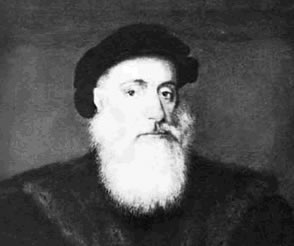
Vasco da Gama was born around 1460 to a noble Portuguese family in Sines, Portugal. His father, Estêvão da Gama, was associated with an earlier plan for a voyage toward India, but the expedition was never carried out by him. In the late 1400s, Portugal was searching for a direct sea route to the trading centers of the Indian Ocean, where valuable products such as spices could be obtained. Portuguese sailors had already spent decades exploring the coast of Africa. In 1488, Bartolomeu Dias successfully rounded the southern tip of Africa at the Cape of Good Hope, proving that Portuguese ships could enter the Indian Ocean by sailing around Africa.
Sailing to India
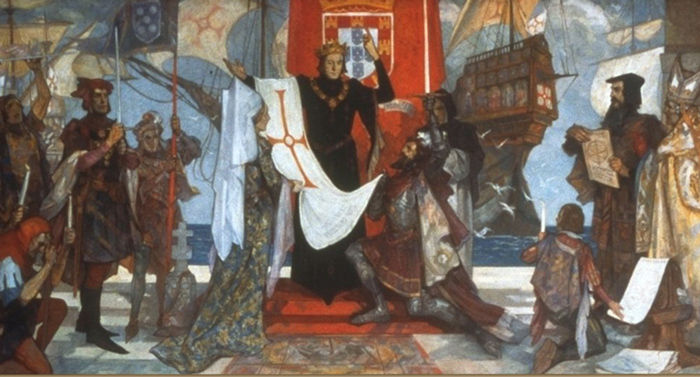
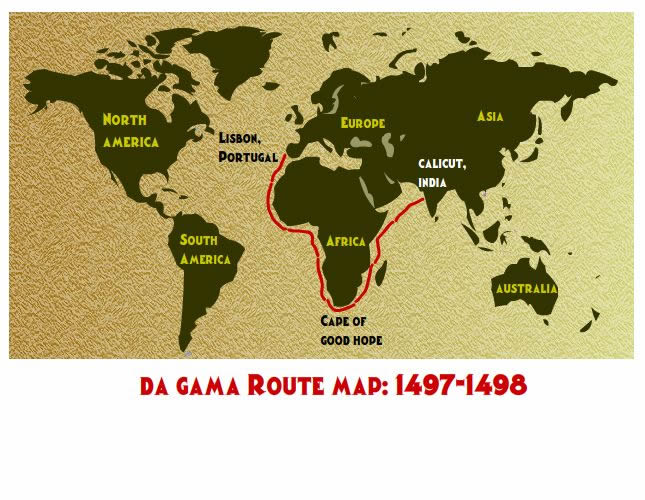
In 1497, Portuguese King Manuel I selected Vasco da Gama to lead an expedition to India. Da Gama left Lisbon on July 8, 1497, with four vessels and roughly 170 men. The expedition sailed far into the South Atlantic before turning back toward southern Africa, a route that helped the ships take advantage of favorable winds. After rounding the Cape of Good Hope, the expedition moved north along the eastern coast of Africa.
Da Gama stopped at several East African ports, including Mozambique and Mombasa, where Portuguese newcomers entered an already well-established Indian Ocean trading world. Muslim, African, Arab, Persian, and Indian merchants had long participated in commercial networks connecting East Africa, Arabia, India, and Asia. Relations between da Gama's expedition and local rulers and merchants were sometimes tense. At Malindi, however, the Portuguese obtained a pilot who helped guide the fleet across the Indian Ocean. Da Gama reached Calicut, on India's Malabar Coast, on May 20, 1498.
Trade in India
Da Gama hoped to establish profitable trade with Calicut, an important center of the spice trade. His arrival did not immediately produce the commercial success the Portuguese expected. The gifts he brought were unimpressive compared with the valuable goods exchanged by established merchants, and negotiations with local authorities became difficult. The Portuguese also faced opposition from some merchants who viewed the newcomers as commercial rivals.
Da Gama left India in August 1498. Before departing, tensions led to the seizure of hostages. The return voyage across the Indian Ocean was extremely difficult. Many crew members died from disease, including scurvy, which results from a severe lack of vitamin C. Only a portion of the original expedition returned to Portugal. Da Gama arrived home in 1499, where the voyage was celebrated because he had successfully established a direct maritime connection between Portugal and India. King Manuel rewarded him and later gave him the title of admiral.
A Violent Second Voyage
In 1502, da Gama returned to the Indian Ocean at the head of a heavily armed Portuguese fleet. The second voyage was very different from his first. Portugal was now attempting to use naval power to force its way into the Indian Ocean trade and weaken competing merchants and ports.
Da Gama's fleet carried out brutal acts of violence. In one notorious episode, the Portuguese seized a Muslim passenger ship commonly called the Miri, carrying hundreds of people returning from Mecca. Da Gama ordered the ship burned after its valuables were taken, killing most of the people aboard. His forces also attacked Calicut, bombarding the city and using executions and intimidation in an effort to impose Portuguese demands. These actions were part of a wider campaign through which Portugal attempted to establish military and commercial power in the Indian Ocean.
Portugal Builds an Indian Ocean Empire
Da Gama returned to Portugal in 1503. Other Portuguese commanders continued the effort to establish fortified bases and control important sea routes. In the decades that followed, Portugal captured or established positions at strategic locations around the Indian Ocean. The sea route pioneered by da Gama's expedition became an important connection between Europe and Asian markets, but Portuguese expansion also brought warfare, coercion, and attempts to dominate existing trading networks.
Final Voyage and Death
More than twenty years after his first voyage, da Gama returned to India for a third time. In 1524, King John III appointed him viceroy of Portuguese India and sent him to address corruption and problems within the colonial administration. Da Gama became ill soon after arriving. He died at Cochin, India, on December 24, 1524. His remains were later returned to Portugal.
Legacy
Vasco da Gama's voyages had enormous consequences. His 1497–1499 expedition established a direct ocean route used by Europeans between Portugal and India around the Cape of Good Hope. That connection helped Portugal build a maritime empire and expanded direct European participation in Indian Ocean commerce. At the same time, da Gama's later expeditions demonstrated the extreme violence that accompanied Portuguese expansion. His story is therefore connected both to exploration and global exchange and to conquest, coercion, and colonialism.
Discussion Questions
- Why was da Gama’s first voyage important even though his initial trading efforts in Calicut were not very successful?
- How did the existing Indian Ocean trading network affect da Gama’s encounters in East Africa and India?
- How was da Gama’s second voyage different in purpose and behavior from his first voyage?
- Why can da Gama’s legacy be understood as involving both exploration and violent imperial expansion?