Early Life
Martha Jane Canary, better known as Calamity Jane, was born in 1852 in Princeton, Missouri. Her childhood was difficult. Her family moved west during the 1860s, and both of her parents died while she was still young. As the oldest of several children, Martha Jane had responsibilities for her younger siblings. She spent much of her life in western frontier communities and became known for riding horses, shooting, traveling through rough country, and taking on jobs that were unusual for women of her era.
Life on the Frontier
Calamity Jane held a variety of jobs during her life. Accounts describe her working as a cook, laundress, nurse, teamster, and performer. She also claimed that she served as a scout for the U.S. Army and took part in military campaigns, although historians have found that many details in her later autobiographical stories are difficult or impossible to verify. The famous story that she earned the nickname “Calamity Jane” after rescuing an Army captain during an attack is also based largely on her own account rather than firm historical evidence.
Jane often wore men's clothing, particularly when riding or working, and she became famous for behavior that challenged nineteenth-century expectations for women. Her reputation for drinking, storytelling, marksmanship, and independence helped turn her into a frontier celebrity. Newspaper writers and dime novels added to her fame, sometimes mixing actual events with exaggeration and invention.
Deadwood and Wild Bill Hickok
In 1876, Calamity Jane traveled to the Black Hills and spent time in Deadwood, Dakota Territory, a rapidly growing mining town. Wild Bill Hickok, the famous gunfighter and lawman, was also in Deadwood that year. Hickok was killed while playing poker on August 2, 1876.
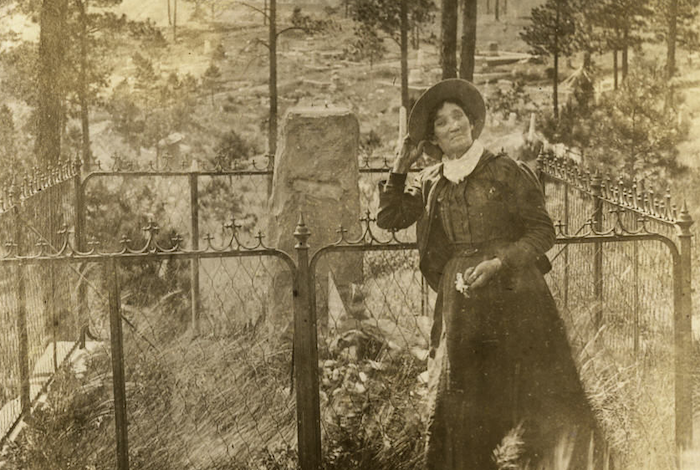
Later stories linked Jane and Hickok romantically, and Jane herself helped encourage some of those stories. Claims that the two were married or had a child together became part of western legend, but historians have not found reliable evidence that they were husband and wife. Whatever the exact nature of their acquaintance, the connection became one of the most enduring parts of the Calamity Jane legend. When Jane died decades later, she was buried near Hickok at Mount Moriah Cemetery in Deadwood.
Caring for the Sick
Stories about Calamity Jane do not focus only on gunfire and adventure. She also developed a reputation for helping people who were sick or in need. One of the best-known accounts describes her nursing residents of Deadwood during a smallpox outbreak. As with many episodes in her life, some details are difficult to document, but accounts of her generosity and willingness to help others became an important part of how people remembered her.
Becoming a Western Celebrity
By the 1890s, Calamity Jane's reputation had become valuable entertainment. She appeared in Wild West exhibitions and other public performances, where audiences wanted to hear stories about the frontier. In 1896, a short booklet titled Life and Adventures of Calamity Jane by Herself was published. It presented dramatic stories about her life, but historians treat many of its claims cautiously because Jane often exaggerated her adventures.
The difference between the historical Martha Jane Canary and the legendary Calamity Jane became increasingly difficult to separate. Popular stories transformed her into a symbol of the Old West: a fearless rider, expert shot, Army scout, friend of famous gunfighters, and independent woman who ignored many social expectations. Some of those descriptions were based on real aspects of her life, while others grew through storytelling and entertainment.
Later Years and Death
Jane's later years were difficult. She struggled financially and had a long reputation for heavy drinking. She continued traveling and occasionally performing, but her health declined. In 1903, she became seriously ill while traveling to the Black Hills. She died near Terry, South Dakota, on August 1, 1903.
Calamity Jane was buried at Mount Moriah Cemetery in Deadwood near Wild Bill Hickok. Her grave became a popular destination for visitors interested in the history and legends of the American West.
Legacy
Calamity Jane remains one of the most recognizable women associated with the Old West. Her life is especially interesting because fact and legend are so closely mixed. She really did live an unconventional frontier life, travel widely, perform publicly, and become famous during her own lifetime. At the same time, many of the most dramatic stories attributed to her came from Jane herself, newspapers, dime novels, promoters, and later popular culture.
Studying Calamity Jane therefore offers more than a story of adventure. It also shows how historical reputations are created. Her story encourages historians to compare claims with evidence and to ask why certain legends survive even when their details cannot be proven.
Five Interesting Facts
- Calamity Jane claimed to have served as a military scout, although many details of those claims remain unverified.
- She became known for helping sick people, including accounts of her nursing people during a smallpox outbreak.
- She frequently wore men's clothing while riding and working on the frontier.
- The exact origin of the nickname “Calamity Jane” is uncertain, despite the colorful stories told about it.
- She was buried at Mount Moriah Cemetery in Deadwood near Wild Bill Hickok.
Timeline
- 1852 – Martha Jane Canary is born in Princeton, Missouri.
- 1860s – Her family travels west, and she loses both parents while still young.
- 1876 – Jane spends time in Deadwood during the same year Wild Bill Hickok is killed there.
- 1890s – She appears in Wild West exhibitions and other public performances.
- 1896 – Life and Adventures of Calamity Jane by Herself is published.
- 1903 – She dies near Terry, South Dakota, and is buried in Deadwood.
Discussion Questions
- Why is it difficult for historians to know which stories about Calamity Jane are completely accurate?
- How did Calamity Jane challenge common expectations for women in the nineteenth-century West?
- Why did the connection between Calamity Jane and Wild Bill Hickok become such an important part of her legend?
- What does Calamity Jane’s story teach us about the difference between a historical person and a popular legend?