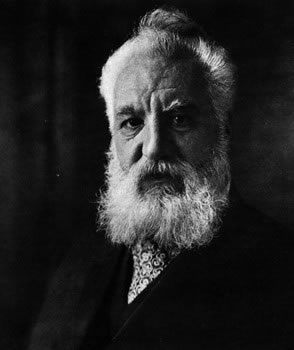
Early Life
Alexander Graham Bell was born in Edinburgh, Scotland, on March 3, 1847. When he was only eleven years old, he invented a machine that could clean wheat. Graham studied anatomy and physiology at the University of London but moved with his family to Quebec, Canada, in 1870.
Working with the Deaf
Bell soon moved to Boston, Massachusetts. In 1871, he began working with deaf people and published the system of Visible Speech that was developed by his father. Visible Speech illustrated how the tongue, lips, and throat are used to produce vocal sounds. In 1872, Bell founded a school for the deaf, which soon became part of Boston University.
Telephone
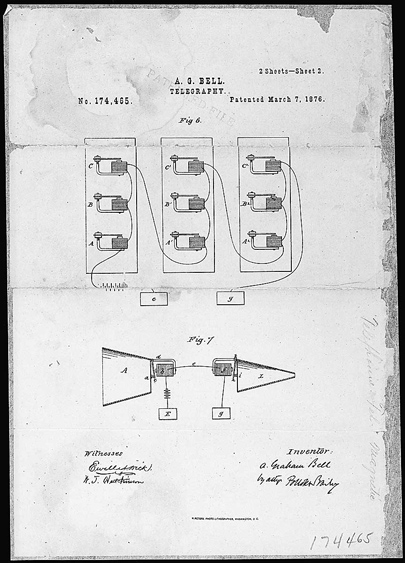
Alexander Graham Bell is best known for his invention of the telephone. While trying to discover the secret to transmitting multiple messages on a single wire, Bell heard the sound of a plucked string along some of the electrical wire. One of Bell’s assistants, Thomas A. Watson, was trying to reactivate a telephone transmitter. After hearing the sound, Bell believed he could send the sound of a human voice over the wire. After receiving a patent on March 7, 1876, for transmitting sound along a single wire, he successfully transmitted human speech on March 10. Bell’s telephone patent was one of the most valuable patents ever issued.
National Geographic
Bell went on to invent a precursor to the modern-day air conditioner and a device called a “photophone” that enabled sound to be transmitted on a beam of light and on which today’s fiber optic and laser communication systems are based. In 1898, Alexander Graham Bell and his son-in-law took over the National Geographic Society and built it into one of the most recognized magazines in the world. Bell also helped found Science Magazine, one of the most respected research journals in the world.
Death
Alexander Graham Bell died August 2, 1922. On the day of his burial, in honor of Bell, all telephone service in the US was stopped for one minute.
Discussion Questions
- How did Bell’s early study of anatomy, physiology, and speech connect with his later experiments in transmitting the human voice?
- Why was hearing the plucked string over electrical wire an important clue for Bell’s telephone experiments?
- How does the photophone show that Bell continued exploring communication beyond the telephone?
- What do Bell’s inventions and his involvement with scientific organizations suggest about the range of his interests?