Curiosities of Childhood
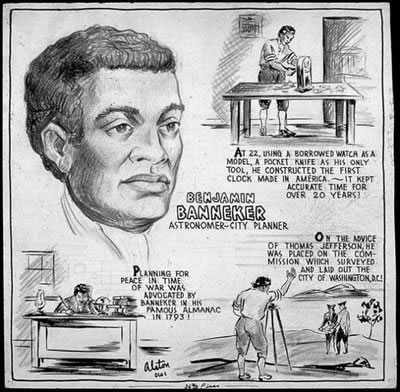
Benjamin Banneker was born on November 9, 1731, in Ellicott City, Maryland. He learned reading and math at an early age from his Quaker grandmother. Once he was old enough to help on his parents’ farm, however, Benjamin’s education ended. Nevertheless, he exhibited an unusual fascination with taking things apart and putting them back together. At the age of twenty-one, Benjamin received his first pocket watch. He was so amazed by the workings of the intricate little machine that he built his own working clock out of wood.
Learning Astronomy
Benjamin soon became a clock and watchmaker. One of his customers was a surveyor named Joseph Ellicott. Ellicott was so impressed by Benjamin’s work that he lent him his books on mathematics and astronomy. By this time, Benjamin was fifty-eight years old. Nevertheless, he began to study astronomy. Benjamin quickly learned astronomy and even made calculations that predicted the times of solar and lunar eclipses. Benjamin wrote down his calculations in his own almanac. He also calculated the position of the planets for each day of the year. His almanac was called Benjamin Banneker’s Pennsylvania, Delaware, Maryland and Virginia Almanack and Ephemeris, for the Year of Our Lord, 1792; Being Bissextile, or Leap-Year, and the Sixteenth Year of American Independence.
Surveying the District of Columbia
At the age of fifty-nine, Benjamin was hired by Andrew Ellicott, the brother of Joseph Ellicott, to assist in surveying the area that would eventually become the District of Columbia. Although Benjamin had to leave the project early because of illness, he forwarded a copy of his almanac to Secretary of State Thomas Jefferson.
Correspondence with Thomas Jefferson
In his correspondences with Jefferson, Benjamin criticized him for his pro-slavery views and urged him to put an end to slavery. Jefferson quickly responded and wrote that he agreed with Benjamin and hoped slavery could be abolished. The correspondence between Benjamin and Thomas Jefferson would subsequently be published in later copies of Benjamin’s almanac.
Banneker's Other Observations
Interestingly, in his single surviving journal, Banneker noted observations of three cycles of the Brood X cicada in 1749, 1766, and 1783. He also documented his observations of honey bees and their hive behaviors.
Legacy

Benjamin died in 1806 as a pioneer in both astronomy and civil rights. Unfortunately, many of his papers and writings were lost in a fire on the day of his funeral. Today, a new monument in Washington, DC is being planned for him.
Discussion Questions
- How did Banneker’s curiosity about mechanical objects connect with his later study of mathematics and astronomy?
- Why did sending his almanac to Thomas Jefferson strengthen Banneker’s argument against racist assumptions about Black intellectual ability?
- How does Banneker’s work on the federal district show a practical use of his mathematical and astronomical knowledge?
- Why is it important to compare the exact content of Jefferson’s reply with later summaries of what Jefferson supposedly promised Banneker?