Reading level: Standard • Click highlighted vocabulary for a definition.
Early Years
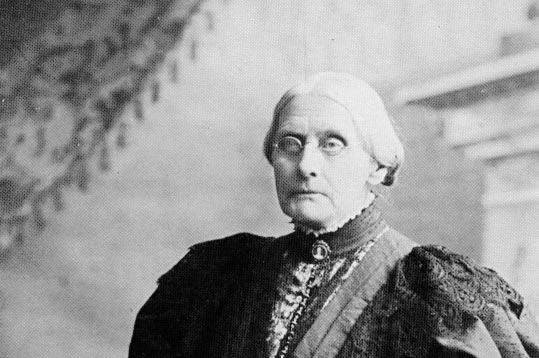
Susan B. Anthony was an American civil rights leader who was instrumental in the quest to grant women the right to vote (suffrage). Susan Brownell Anthony was born the daughter of Quaker parents on February 15, 1820, in Adams, Massachusetts. The family moved to New York State, where Susan received her education at a school her father ran. At school, she developed political inclinations and took a strong stance against slavery.
Fighting for Women's Rights
In 1854, Anthony devoted herself to the rights of women and advocated complete equality between men and women. Anthony and Elizabeth Cady Stanton published the weekly paper The Revolution, which contained equality literature and other political messages. She became vice president at large of the National Woman Suffrage Association (NWSA) from 1869 until 1892, when she became president. On November 5, 1872, Anthony asserted her 14th Amendment right (to vote) and voted for Ulysses S. Grant in the presidential election. At the time, it was illegal for women to vote and Anthony was arrested. In 1878, women’s suffrage was introduced to Congress, but the idea floundered for many years. Anthony, however, worked hard to promote women's rights. She traveled far and wide and gave anywhere from 75 to 100 speeches each year. In the meantime, Anthony and several other women published The History of Woman Suffrage in 1884. It wasn’t until 1920 that the 19th Amendment (allowing women to vote) was ratified in Congress - 14 years after her death. Susan B. Anthony was honored on the US dollar coin minted in 1979. She was the first woman to be honored on a united States coin.
Susan B. Anthony $1 Coin
Discussion Questions
How did Anthony’s Quaker upbringing and opposition to slavery help shape her later reform work?
Why did Anthony believe the Fourteenth Amendment supported her attempt to vote in 1872?
How did Anthony and Elizabeth Cady Stanton use organizations, newspapers, books, and speeches to promote woman suffrage?
Why is it significant that Anthony died before the Nineteenth Amendment was ratified?
🔎 Susan B. Anthony Scavenger Hunt
Early Years
Susan B. Anthony was an American civil rights leader who was instrumental in the quest to grant women the right to vote (suffrage). Susan Brownell Anthony was born the daughter of Quaker parents on February 15, 1820, in Adams, Massachusetts. The family moved to New York State, where Susan received her education at a school her father ran. At school, she developed political inclinations and took a strong stance against slavery.
Fighting for Women's Rights
In 1854, Anthony devoted herself to the rights of women and advocated complete equality between men and women. Anthony and Elizabeth Cady Stanton published the weekly paper The Revolution, which contained equality literature and other political messages. She became vice president at large of the National Woman Suffrage Association (NWSA) from 1869 until 1892, when she became president. On November 5, 1872, Anthony asserted her 14th Amendment right (to vote) and voted for Ulysses S. Grant in the presidential election. At the time, it was illegal for women to vote and Anthony was arrested. In 1878, women’s suffrage was introduced to Congress, but the idea floundered for many years. Anthony, however, worked hard to promote women's rights. She traveled far and wide and gave anywhere from 75 to 100 speeches each year. In the meantime, Anthony and several other women published The History of Woman Suffrage in 1884. It wasn’t until 1920 that the 19th Amendment (allowing women to vote) was ratified in Congress - 14 years after her death. Susan B. Anthony was honored on the US dollar coin minted in 1979. She was the first woman to be honored on a united States coin.
Susan B. Anthony $1 Coin
Early Years
Susan B. Anthony was born in Adams, Massachusetts, in 1820 and grew up in a Quaker family. She became a teacher and an opponent of slavery. She later devoted much of her life to expanding women’s rights, especially the right to vote.
Working for Woman Suffrage
Anthony worked closely with Elizabeth Cady Stanton. They helped publish The Revolution and in 1869 helped form the National Woman Suffrage Association, which focused on a federal constitutional amendment protecting women’s voting rights.
Voting in 1872
Anthony argued that the Fourteenth Amendment gave women citizens the right to vote. She cast a ballot in the 1872 presidential election in Rochester, New York. She was arrested, tried, found guilty, and fined $100. Anthony refused to pay the fine.
The Nineteenth Amendment
Anthony died in 1906 and did not live to see the Nineteenth Amendment ratified. Congress proposed the amendment in 1919, and the states completed ratification in 1920. The amendment prohibited denying the right to vote on account of sex.
Honored on a Dollar Coin
The Susan B. Anthony dollar entered circulation in 1979. The U.S. Mint describes it as the first U.S. circulating coin to feature a non-mythical woman. Anthony’s portrait appears on the front of the coin.