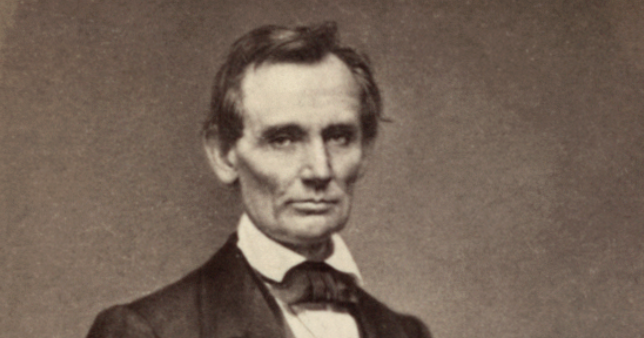
One enduring legend surrounding Abraham Lincoln is the story of his humble beginnings in a log cabin. While Lincoln was indeed born in a log cabin in Hardin County, Kentucky (now LaRue County) in 1809, the cabin itself became a symbol of his rise from modest circumstances to the highest office in the land.
Lincoln's formal education consisted of roughly a year's worth of schooling in total. He attended various "blab schools" or "ABC schools," which were informal, short-term schools in which students learned basic reading, writing, and arithmetic. His education was sporadic and often interrupted by the demands of farm work.
Lincoln was largely self-taught and had a strong desire for learning. He read voraciously, often borrowing books from neighbors and local libraries. He educated himself through reading and studying on his own, covering a wide range of subjects including law, literature, history, and politics.
Despite his limited formal education, Abraham Lincoln's insatiable appetite for knowledge, his intellectual curiosity, and his determination to succeed, eventually led him to become a highly successful lawyer, statesman, and, of course, the 16th President of the United States. His commitment to self-improvement and lifelong learning is one of the remarkable aspects of his legacy.
Abraham Lincoln is often referred to as "Honest Abe," a nickname rooted in a story from his youth. Legend has it that Lincoln once walked several miles to return a few pennies he had overcharged a customer. While this story may be embellished, it emphasizes the idea of Lincoln's integrity and honesty.
Another enduring tale portrays Lincoln as a skilled rail-splitter, suggesting that he earned his living by splitting logs for fences. It is likely that his father "rented" his son's wood cutting and rail-splitting services to other frontiersman.
Lincoln's reputation as a rail splitter became well-known during his political career. It was used as a symbol of his humble beginnings and his connection to the common working people. During his successful 1860 presidential campaign, the image of Lincoln as a rail splitter was popularized and contributed to his image as a self-made man who had risen from modest circumstances.
One of the more haunting legends is the story that Abraham Lincoln had a dream of his own assassination a few days before he was shot by John Wilkes Booth. In this dream, Lincoln saw himself in a funeral setting at the White House. While this tale is based on historical accounts, it has taken on a somewhat mythic quality.
These legends about Abraham Lincoln, whether grounded in truth or embellished by time, add depth to the complex legacy of one of America's most revered figures. They remind us of the enduring fascination and reverence for a man whose impact on history continues to be felt to this day.