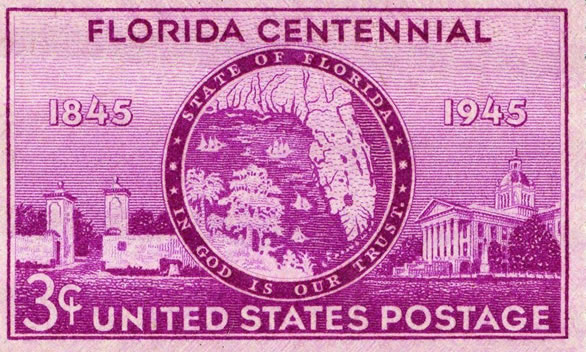
The acquisition of Florida, which occurred during America's Era of Good Feeling, was considered a triumph for American diplomacy. America had attempted many times to initiate the purchase of Florida from Spain, but was rejected each time. By 1819, however, Spain was in a difficult position. Its empire in North America was crumbling, and several of its Central and South American colonies began clamoring for independence. Furthermore, American military forces had invaded and occupied Florida as a result of the First Seminole War in an effort to stop the Seminoles from raiding American settlements in Georgia. Fresh off the brutal Napoleonic Wars in Europe, and eager to establish control in its colonies, Spain agreed to relinquish Florida to the United States.
The 1821 Adams-Onis Treaty settled a bitter land dispute between Spain and the United States concerning the boundaries of the land acquired by the United States from France as a result of the Louisiana Purchase and other lands. In the agreement, the United States acquired Spanish Florida (which included Spain's claims to Louisiana) in exchange for payments by the United States of residents' claims against the Spanish government up to a total of $5,000,000. In addition, the United States agreed to give up its claims to parts of Texas and the desert southwest and Spain gave up its claims to the Oregon Territory north of the 42nd Territory.
|