Precambrian Period
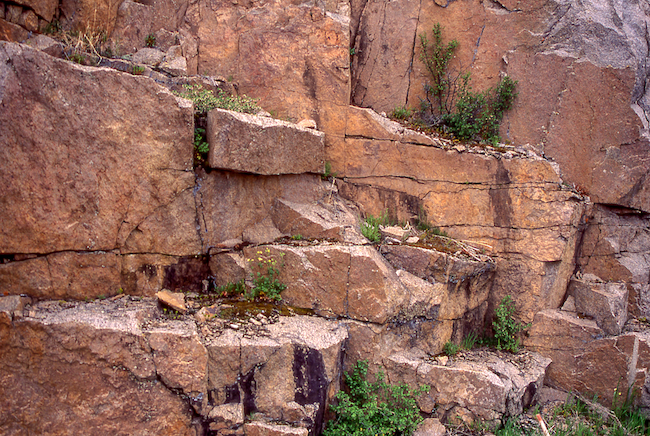 |
| Precambrian Period Rock Formations |
Image Credit: National Park Service - Public Domain |
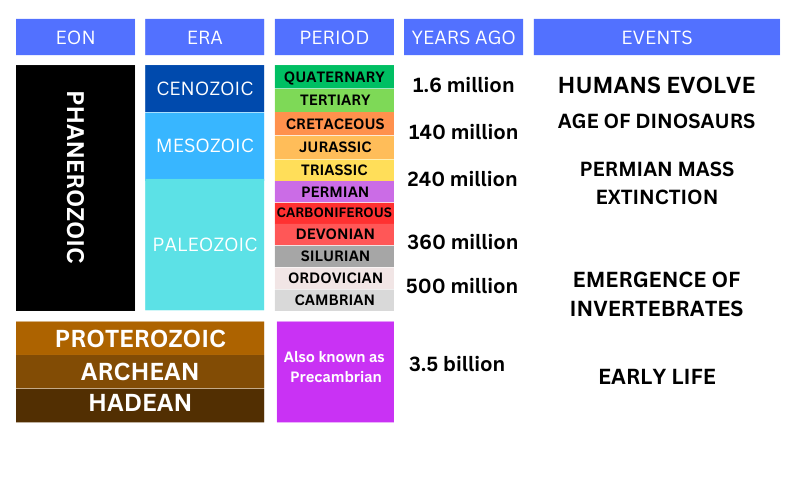
The Pre-Cambrian Eon, spanning an immense stretch of time from approximately 4.6 billion to 541 million years ago, remains one of the most mysterious and least understood chapters in Earth's geological history. This vast eon encompasses nearly 90% of our planet's existence and lays the foundation for the emergence of life as we know it today.
Divisions of the Pre-Cambrian:
The Pre-Cambrian Eon is traditionally divided into three major subdivisions: the Hadean, the Archean, and the Proterozoic. Each subdivision represents distinct stages in the early evolution of Earth, characterized by the formation of the planet, the emergence of the first oceans and continents, and the eventual development of complex life forms.
-
Hadean Eon (4.6 billion to 4 billion years ago): The Hadean marks the earliest phase of Earth's existence, named after the hellish conditions prevalent during this time. It was a period of intense heat, frequent asteroid bombardment, and the formation of Earth's initial crust and oceans.
-
Archean Eon (4 billion to 2.5 billion years ago): During the Archean, Earth's surface underwent significant transformations. The first continents began to take shape, and primitive forms of life, likely single-celled organisms, appeared in the oceans. The atmosphere started to accumulate oxygen through the process of photosynthesis, paving the way for more complex life in the future.
-
Proterozoic Eon (2.5 billion to 541 million years ago): The Proterozoic witnessed the continued evolution of Earth's geology and the proliferation of diverse life forms. Oxygen levels in the atmosphere increased, leading to the development of more complex organisms. The first eukaryotic cells and multicellular life emerged during this eon.
Life in the Pre-Cambrian:
The question of when life first appeared on Earth is central to understanding the Pre-Cambrian Eon. While direct evidence is scarce due to the lack of well-preserved rocks from this ancient period, the discovery of microfossils and stromatolites in certain rock formations suggests the presence of simple, single-celled organisms as far back as 3.5 billion years ago.
Stromatolites, layered structures formed by the activity of microbial communities, provide some of the earliest indirect evidence of life on Earth. These ancient organisms likely played a crucial role in shaping the planet's environment and laying the groundwork for the more complex life forms that would follow.
Geological Evolution:
The Pre-Cambrian Eon witnessed significant geological events that shaped the Earth's surface. From the formation of the first continents to the development of diverse landscapes and the evolution of the atmosphere, the Pre-Cambrian set the stage for the dynamic planet we inhabit today.