Phanerozoic Eon
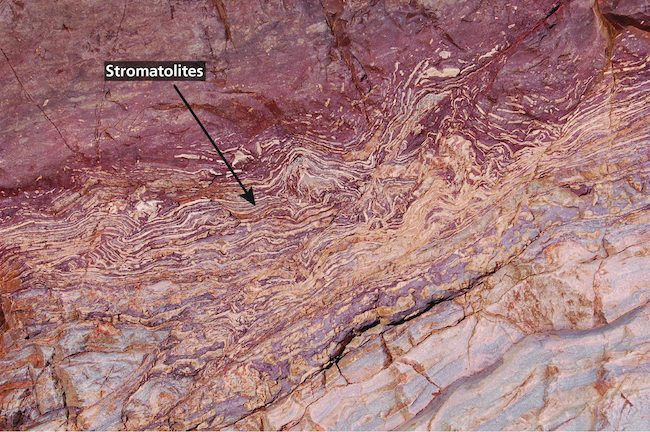 |
| Stromatolites in the Grand Canyon |
Image Credit: National Park Service - Public Domain |
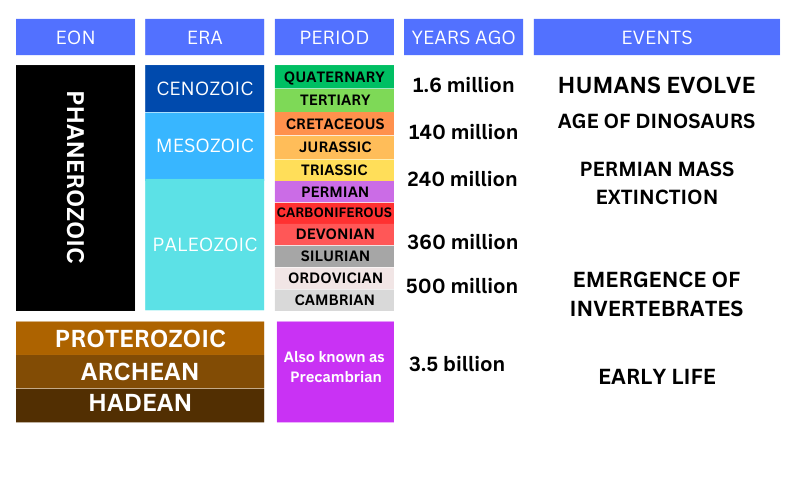
The Phanerozoic Eon, spanning from approximately 541 million years ago to the present day, represents the most recent chapter in Earth's geological history. Characterized by a remarkable diversity of life forms, geological events, and climate fluctuations, the Phanerozoic Eon has witnessed the evolution of complex ecosystems, the rise and fall of species, and the development of the diverse life we observe today.
Divisions of the Phanerozoic:
The Phanerozoic Eon is divided into three major eras: the Paleozoic, the Mesozoic, and the Cenozoic. Each era is marked by distinctive geological and biological events that have shaped the course of life on Earth.
-
Paleozoic Era (541 million to 252 million years ago): The Paleozoic Era is characterized by significant evolutionary events, including the Cambrian Explosion, the colonization of land by plants and animals, the development of complex marine ecosystems, and the formation of the supercontinent Pangaea.
-
Mesozoic Era (252 million to 66 million years ago): Often referred to as the "Age of Dinosaurs," the Mesozoic Era witnessed the dominance of reptiles, including the iconic dinosaurs. It also saw the emergence of flowering plants, the evolution of birds, and the breakup of Pangaea.
-
Cenozoic Era (66 million years ago to the present): The Cenozoic Era is marked by the diversification of mammals, including the rise of primates and the evolution of hominids leading to the emergence of Homo sapiens. It also includes the Pleistocene epoch, characterized by ice ages, and the ongoing Holocene epoch, during which human civilization has flourished.
Biological Evolution and Diversity:
The Phanerozoic Eon is distinguished by a surge in biological diversity and complexity. The Cambrian Explosion during the Paleozoic Era marked a rapid diversification of marine life, leading to the emergence of various phyla. The colonization of land by plants and animals during the Silurian and Devonian periods further expanded the range of ecosystems.
The Mesozoic Era is synonymous with the dominance of dinosaurs, which were part of a rich tapestry of life that included early mammals, birds, and diverse plant species. The Cenozoic Era saw the decline of dinosaurs and the rise of mammals, leading to the evolution of primates and, eventually, the appearance of humans.
Mass Extinctions and Geological Events:
Throughout the Phanerozoic Eon, the Earth experienced several mass extinctions, including the Permian-Triassic extinction, which wiped out nearly 96% of marine species, and the Cretaceous-Paleogene extinction, responsible for the demise of the dinosaurs. These events were often associated with significant geological phenomena such as volcanic activity, asteroid impacts, or climate changes.
Continental Drift and Climate:
The movement of Earth's continents played a crucial role in shaping the climate and biodiversity during the Phanerozoic. The breakup and drift of continents influenced ocean currents, climate patterns, and the evolution of species across different regions.