Paleozoic Era
 |
| Mesozoic Era Reptiles |
Image Credit: The Wonderful Paleo Art of Heinrich Harder - Heinrich Harder - Public Domain |
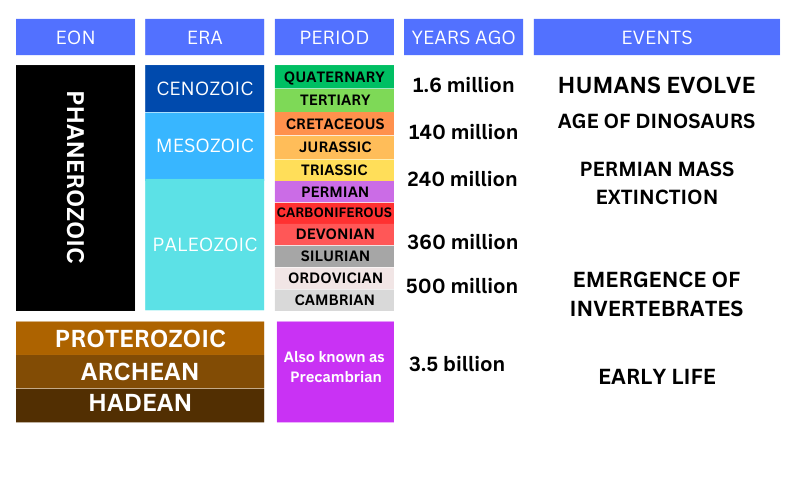
The Paleozoic Era, spanning a vast stretch of geological time from approximately 541 to 252 million years ago, represents a pivotal chapter in Earth's history. It is characterized by significant evolutionary innovations, the emergence of complex life forms, and transformative geological events. Often referred to as the "Age of Invertebrates," the Paleozoic laid the foundation for the diverse ecosystems and life forms that would come to dominate the planet in subsequent eras. In this article, we delve into the key periods of the Paleozoic Era and explore the evolutionary milestones that shaped the ancient world.
Cambrian Period (541 to 485 million years ago):
-
Explosion of Life:
- The Cambrian Period marked a profound burst of biological diversity known as the Cambrian Explosion. During this time, the fossil record reveals the sudden appearance of a wide array of complex, multicellular organisms, including the first recognizable animals with hard skeletons.
-
Trilobites and Early Marine Life:
- Trilobites, iconic arthropods with segmented bodies, eyes, and exoskeletons, were among the dominant marine organisms of the Cambrian. Other notable life forms included brachiopods, mollusks, and the first chordates.
Ordovician Period (485 to 443 million years ago):
-
Diversification Continues:
- The Ordovician Period witnessed the continued diversification of marine life. Coral reefs became more prevalent, and new groups of marine organisms, including cephalopods and jawless fish, appeared.
-
Mass Extinctions:
- Despite the flourishing biodiversity, the Ordovician ended with significant mass extinctions, likely triggered by glaciations and changes in sea levels. These events paved the way for the Silurian Period.
Silurian Period (443 to 419 million years ago):
-
Colonization of Land:
- The Silurian is marked by the colonization of land by plants and early arthropods. The first vascular plants appeared, contributing to the development of terrestrial ecosystems.
-
Diversification of Fish:
- Fish continued to evolve during the Silurian, with jawed fish becoming more prevalent. The first evidence of fish with paired fins, a significant adaptation for maneuverability, is documented in this period.
Devonian Period (419 to 359 million years ago):
-
Age of Fishes:
- The Devonian is often called the "Age of Fishes" due to the diversification and dominance of various fish groups. Jawed fish, including armored placoderms and lobe-finned fish, were abundant.
-
Transition to Tetrapods:
- Towards the end of the Devonian, vertebrates adapted to terrestrial life, giving rise to the first tetrapods—four-limbed vertebrates. This transition laid the groundwork for the eventual colonization of land by vertebrates.
Carboniferous Period (359 to 299 million years ago):
-
Coal Forests and Amphibians:
- The Carboniferous is renowned for the formation of extensive coal forests, composed mainly of ferns and seed plants. Amphibians, the first vertebrates adapted to life on land, became diverse during this period.
-
Insects and Giant Arthropods:
- Insects evolved and diversified during the Carboniferous, with dragonflies reaching impressive sizes. Giant arthropods, such as the meter-long millipede Arthropleura, roamed the lush landscapes.
Permian Period (299 to 252 million years ago):
-
Dominance of Reptiles:
- The Permian Period witnessed the rise of reptiles, including the early archosaurs and the diverse synapsids. Reptiles became the dominant terrestrial vertebrates, paving the way for the subsequent Mesozoic Era.
-
Mass Extinctions:
- The Paleozoic Era concluded with the largest mass extinction event in Earth's history, known as the Permian-Triassic extinction event. This catastrophic event wiped out approximately 96% of marine species and 70% of terrestrial vertebrates, marking the boundary between the Paleozoic and Mesozoic eras.