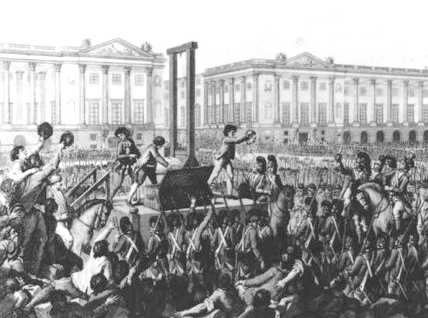
In the early 1790s , events in France would further divide the two political parties and lead to unprecedented episodes of political "mudslinging," accusation, and threats of unrest. On July 14, 1789, the medieval fortress known as the Bastille, which was said to represent the tyranny of the French Monarchy, was sacked, serving as the flashpoint for the French Revolution. In perhaps the darkest era in French history, France's social and political systems were completely sacked by radical political groups and masses of poor "citizens." The monarchy was overthrown and King Louis XVI, who was instrumental in the victorious result of the American Revolution, and his queen, Marie Antoinette, were beheaded along with thousands of others who spoke out against the radicals. In a period of time that came to be known as "The Enlightenment," France's former society built on aristocratic and feudal privileges was chaotically transformed into one that supposedly honored reason and the unalienable rights of men. The French Revolution would stir passionate feelings of support and opposition in America. With the onset of the French Revolution and the subsequent execution of the King and Queen of France, Hamilton and the Federalist Party took the position of opposition toward the Revolution and warned that the Republican Party had visions of a similar revolution in America. Republicans supported the Revolution and overthrow of the monarchy, and accused Federalists of making secret deals with England and of trying to establish a monarchy in America. All across America, support for the French Revolution was strong. Numerous "Jacobin" clubs sprouted up, professing their political support for the ideals of the French Revolution. "Jacobin" was the French term that referred to a political radical. |