Great Horned Owl
|
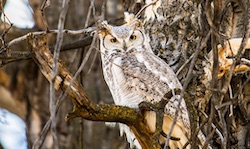
The Great Horned Owl (Bubo virginianus) is a formidable predator with distinctive "horns" or ear tufts and vivid yellow eyes. Measuring up to 25 inches in length, the great horned owl is well-adpated to the boreal forest's varied ecosystems. Females often lay eggs in the dead of winter, and it is not unusual for her to be incubating while covered in snow. This nocturnal owl, often heard during the night, is an apex predator, playing a crucial role in regulating the forest's rodent populations, preying on small rodents, squirrels, rabbits, grouse, and even other owls. Great horned owls are one of the few predators known to take skunks. |
Long-eared Owl
|
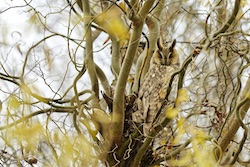
The Long-eared Owl (Asio otus), sometimes called the cat owl, is found throughout the boreal forest in both the Eastern and Western Hemispheres. Measuring about 16 inches in length, it is recognized by its long tufts of feathers resembling "ears." Scientists are not sure of the purpose of ear tufts, but they may function to communicate mood or intent. Typically residing in dense coniferous forests, this owl preys on small mammals. Known for its cryptic plumage, this owl is a master of camouflage, blending seamlessly into its surroundings. Despite its nocturnal habits, the Long-eared Owl occasionally hunts during the day, showcasing its adaptability in the boreal environment. Unlike most owls, long-eared owls are known to from large communal roots of up to 50 birds! |
Boreal Owl
|
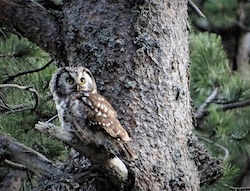
The Boreal Owl (Aegolius funereus) is a petite owl well-adapted to the boreal forest's cold climate. With a distinctive facial pattern, it preys on small rodents and birds. Nesting in tree cavities, this owl relies on mature coniferous stands for breeding. Despite its diminutive size, the Boreal Owl's haunting calls echo through the northern forests, making it a mysterious and integral part of the boreal ecosystem. |
Northern Hawk Owl
|
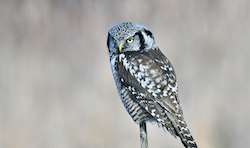
The Northern Hawk Owl (Surnia ulula) is a diurnal (active during the day) owl with a hawk-like appearance and behavior. These birds measure about 15 inches in length. Like most owls, females are slightly larger than males. Known for perching conspicuously while hunting, it feeds primarily on small mammals and birds. Like other owls, it is known to plunge headfirst into snow to trap prey. Thriving in open boreal landscapes, this owl is highly territorial, defending its hunting grounds vigorously. This owl is found through the boreal forest in North America, Europe, and Asia. |
Saw-whet Owl
|
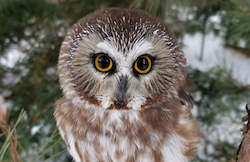
The Northern Saw-whet Owl (Aegolius acadicus) is a small owl species that inhabits the boreal forest. It is named for its unusual call, which sounds like a saw being sharpened. Difficult to observe because of nocturnal habits, and small size (it grows to about seven or eight inches in length), ornithologists aren't sure how common or how rare this species is. These owls feed on small mammals and birds, and nest in tree cavities. Interestingly, Saw-whet owls allow close approach when they are detected by people, and may even allow themselves to be handled. |
Barred Owl
|
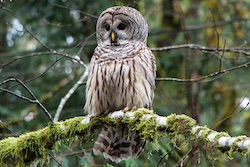
The Barred Owl (Strix varia) inhabits the boreal forest, captivating observers with its haunting hoots, primeval screams, and distinctive barred plumage. Measuring up to 22 inches in length, and recognizable by its dark eyes, rounded face, and prominent feather patterns, this nocturnal owl is a skilled hunter, preying on small mammals and birds. In wetland habitats, they are known to hunt crayfish. With an adaptable nature, Barred Owls thrive in various forested habitats, from dense woodlands to urban areas. Barred owls nest in tree cavities but will also use large, man-made birdhouses. |
Great Gray Owl
|
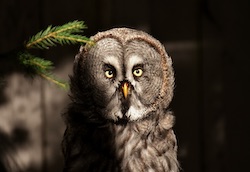
The Great Gray Owl (Strix nebulosa) commands attention in the boreal forest with its majestic stature and distinctive appearance. Found throughout the boreal forest in both the Western and Eastern Hemispheres, it is the world's largest owl in terms of length. Despite its larger size, it is lighter than both the snowy and great horned owls. Much of its mass comes from its thick layers of feathers. Sporting a large facial disc, intense yellow eyes, and intricate barred plumage, this iconic owl is the epitome of silent grace in flight. Preferring open coniferous forests, it relies on acute hearing to detect prey, primarily small mammals. In snowy conditions, it will dive head-first into the snow to capture prey. This hunting technique is known as "snow-plunging." |