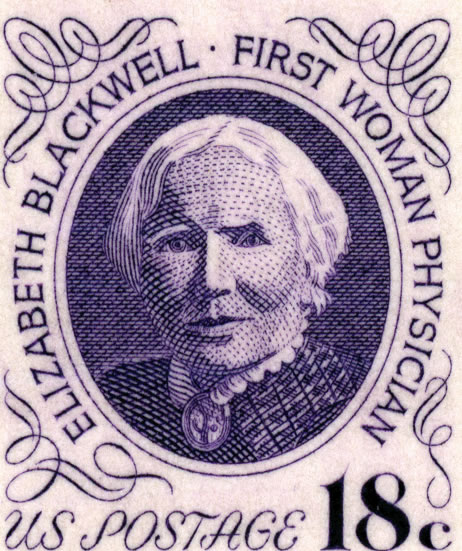
Introduction
Elizabeth Blackwell was born February 3, 1821, in Bristol, England. She had four brothers and four sisters. Mr. Blackwell believed that each child should have a chance to develop his/her talents and had the children educated by private tutors.
Early Life
In 1832, her father moved the family to the United States, where he set up a sugar refinery in New York City. Mr. Blackwell took Elizabeth to abolitionist meetings in the 1830s. The family hid an escaped slave who was on his way to Canada in their home for several weeks. In 1838, the family moved to Cincinnati, Ohio. Mr. Blackwell wanted to raise sugar beets as a better source of sugar because he was opposed to the strenuous slave labor needed to grow and process sugar cane. Unfortunately, just three weeks after the move, Elizabeth’s father died. Elizabeth and her sisters became teachers to help support their family.
Elizabeth Decides to Become a Doctor
Elizabeth was inspired to become a doctor after one of her friends, who was dying of a painful disease, admitted her condition would be easier for her handle if she had a female doctor. Elizabeth promptly took a job teaching music to raise money to pay for medical school. She studied a friend’s medical books and studied anatomy with a doctor, but was continually denied entrance to medical school. Some doctors recommended that she either go to Paris or disguise herself as a man in order to study medicine. Others discouraged her because they thought women were intellectually inferior. Finally, in 1847, she was accepted into the Geneva Medical College in upstate New York. In 1849, Blackwell graduated first in her class and became the first woman to earn a medical degree in the United States.
Fallout with Florence Nightingale
Elizabeth continued her education by taking a midwifery course at La Maternité in Paris. While treating a sick child, she got a serious eye infection, which made it necessary to remove her left eye. She was forced to give up her dream to become a surgeon. She never married, but she adopted an Irish orphan named Kitty Barry in 1856 and continued in her quest to help empower women. Elizabeth and Florence Nightingale become friends over the years and discussed opening a hospital together. Their plans, however, fell apart because Florence wanted Elizabeth to train nurses rather than train female physicians.
During the Civil War
In 1853, Elizabeth and Marie Zakrzewska, a German doctor, founded the New York Infirmary for Indigent Women and Children. During the Civil War, Elizabeth supported the North because of her abolitionist roots. She and her sister Emily, who had also become a doctor, worked as nurses during the war. The New York Infirmary worked with Dorothea Dix to train nurses for the Union. In 1874, Elizabeth helped start the London School of Medicine for Women.
Legacy
Elizabeth Blackwell was a pioneer for medical education for women who overcame many social prejudices in order to become a doctor. She made it possible for other women to follow in her footsteps. She died May 31, 1910, in Hastings, England.
Discussion Questions
- What experiences helped shape Elizabeth Blackwell's early life?
- What major challenge or turning point appears in Elizabeth Blackwell's story?
- What evidence in the biography shows why Elizabeth Blackwell became well known?
- Which detail from the biography best explains Elizabeth Blackwell's lasting significance?